Showing posts with label Book Review. Show all posts

Wednesday, August 9, 2017

Jason Reynolds & Miles Morales

When Jason Reynolds' agent called him about writing a book about Miles Morales, the first thing he said was: "Never heard of him."  "He's a Spider-Man in Brooklyn who's black and Puerto Rican," she explained.  He paused.  "Continue..."

Throughout his work, Reynolds has written with the intention to teach young boys of color how to become men, so it made sense for him to have an instant interest in writing a YA novel for Miles.  That and it's Marvel.  There was just one small request from Disney: that he write the book in twenty-eight days.  He had to cut himself off from the world to do it, but he succeeded in weaving a narrative that may have a keener awareness for Miles than even the comic books did.

If you haven't read Miles Morales: Spider-Man, the quick run down is that Miles' spidey sense is on the fritz and he's just been suspended from his private school for constantly leaving to "go to the bathroom."  This causes tension with his family, particularly his father, who is adamant that Miles doesn't fall into the same criminal habits as his uncle.

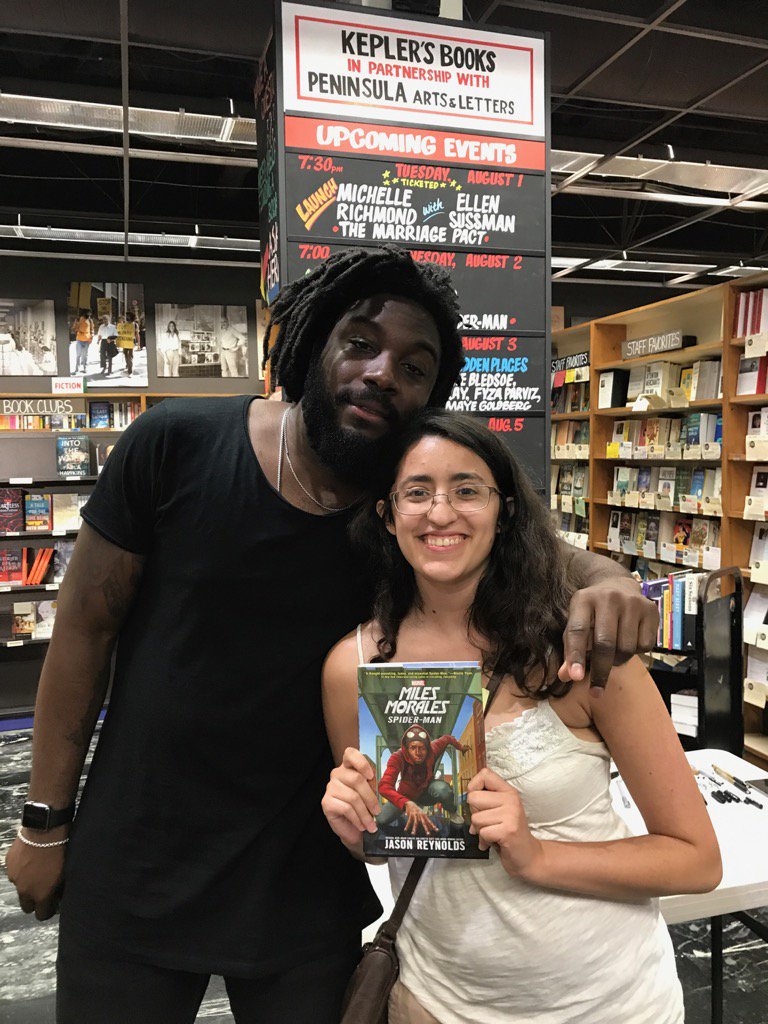
When Reynolds kicked off the release of Miles Morales: Spider-Man at an indie bookstore (which was fitting since he's the 2017 Indies First Spokesperson), he talked about the hiccups in the character's comic book background that he had to address.  "His father's name is Jefferson Davis, first of all," he said, pausing to let the audience absorb this.  Miles Morales, an Afro-Puerto Rican teenager/superhero, has a black father named after the president of the Confederacy.  Uh-oh.

"Then I realized that Ganke is Korean but that's not a Korean name," Reynolds continued.  "And if Miles' mother is Puerto Rican, she's probably - speaking generally here - she's probably Catholic and would change her name.  So why does Miles have her last name?"  In the book, Miles explains that his father and uncle made Davis a bad name back in the day, so that was why he goes by Morales.  The characters acknowledge the strangeness of other two name problems later in the book, though they can't give an answer to them.

As for the Peter Parker Spider-Man, Reynolds always thought the famous line "With great power comes great responsibility" sounded silly in a fifteen-year-old mouth.  "If I got powers, I'd be thinking a whole lot of other things first," said Reynolds.  He expressed his interest in expanding Miles' identity as a superhero of color who does not automatically have the same privileges as the likes of Peter Parker.  How could Miles be saving the world when his own neighborhood needed saving?

In the novel, Reynolds explores the "survivor's guilt" that Miles feels not only for making it to a private school but also gaining supposedly undeserved powers.  When his spidey sense goes out of wack, Miles repeatedly wonders if his time has a hero has run out.  If he'll inevitably go back to the hustling in his veins.  Miles' conflict sharpens whenever he has a conversation with his father, who had narrowly escaped Uncle Aaron's fate by turning his life around in his youth and who repeatedly emphasizes that he is Miles Morales' father, not Spider-Man's.

Over and over Miles hears the words "You're just like me" in his nightmares, in his day-to-day life, everywhere.  He hears the warning that he will turn out just like his uncle.  Like how every other brown kid is expected to turn out.  It's the fear that plagues real kids like Miles who made it into the good school to help them get out of their rough neighborhood, only to be thrown into the school to prison pipeline as they experience harsher discipline than their white peers.

"It has to matter that he's black and Puerto Rican, " said Reynolds.  And he does make it matter.  When you realize what Miles is up against in the book, you know that it's intertwined with his racial identity and family roots.  Miles' reality is harder because of his skin color.  The book makes no qualms about acknowledging that and does not neatly resolve Miles' problems.  As a result, the novel's last scene reverberates with a power that only an author like Reynolds could pull off.

As if Reynolds hadn't already won me over enough, he also discussed his mission to deconstruct toxic masculinity in his writing.  "In my stories, I have a brown boy who is terrified," said Reynolds.  In Miles Morales: Spider-Man, Miles' crush calls him out on his fear.  Reynolds also talked about an alternate narrative of men fumbling like nervous wrecks instead of boasting about their womanizing ways.  Reynolds illustrates such a narrative when Miles' father tells Miles that he spilled salsa all over his mother when they first met and that Miles should go ahead and "spill the salsa" on his crush.  It's a more lighthearted refrain in the novel, but no less powerful in showing a different way to be a man.

If none of that is enough to convince you that Miles Morales: Spider-Man is worth reading, I don't know what to do with you.  But if you have any interest in Miles as a character or in Reynolds' mission as a writer, I highly recommend you go to the closest indie bookstore and buy a copy ASAP.
DGR1YP0VoAA4Gxm
Me and Jason Reynolds at Kepler's Books

Monday, July 3, 2017

Ahsoka: A Star Wars Story

For fans of the animated series Star Wars: The Clone Wars, E.K. Johnston’s novel Ahsoka is required reading.  In the TV series, we saw Ahsoka Tano transform from the brash and sassy Padawan, to the experienced young general, to the Jedi who left the Order after a loss of faith.  Johnston continues the Ahsoka character arc we deserved in the tragically cancelled Clone Wars.  Ahsoka, who was already struggling to find her new place in the world, has become even more untethered now that most of the Jedi have been wiped out and she can no longer sense her former masters.

(Source: Wikipedia)
Ahsoka spends most of the novel on a moon called Raada in the outskirts of the galaxy, where she meets a small, quiet community of farmers - including a young woman named Kaeden.  I assume Kaeden is a black woman from the description of her skin color and hair, but what I know for sure is that Kaeden is the first (confirmed) gay character that I’ve come across in the Star Wars universe.  Kaeden’s unrequited feelings for Ahsoka are obvious to everyone except Ahsoka - which is unfortunate, but perhaps for the better since the Star Wars universe has not proven to be relationship-friendly.  Meanwhile, the Empire starts to wreak havoc on Raada, and Ahsoka has to navigate her secret identity and her desire to help people.  I liked getting inside Ahsoka’s head in a way that I never got to while watching her in The Clone Wars.  Because I was reading a novel, I could see her in her tactical mode, her meditations, and her moments of vulnerability in a more intimate setting.

I love how Ahsoka has come into her own in this novel.  She’s always had a strong tactical mind and sense of empathy, traits that she has had to sharpen without the guidance of Anakin or Obi-Wan.  However, she seems to have achieved a balance and control that Anakin never could.  Ahsoka keeps her emotions in check when she is strategizing for her survival or for a mission, but she allows her loyalty and emotional ties to her friends motivate her to save them despite personal risk.  She’s taken the best of Anakin’s heart and Obi-Wan’s mind to become a tempered, quick-thinking, and compassionate fighter under pressure.  It hurts to see how much she misses them.  But if nothing else, they trained her well.

Ahsoka leaves the Jedi Order
(Source: StarWars.com)
The novel is interspersed with flashbacks, mostly from Ahsoka but also from Anakin and Obi-Wan.  All of them will make you sad.  If you’re a masochist like me and want to increase your suffering, linger on the first flashback from Ahsoka featuring the old nickname “Snips” or, even worse, the flashback from Anakin: “Anakin had never put in for a Padawan of his own.  He didn’t want it to look like he was pushing Obi-Wan aside.  Now, Obi-Wan had gone and done it first, and Anakin still wasn’t sure how he felt about it.”  THESE ARE NOT THE TEARS YOU’RE LOOKING FOR. *sniffle*

During The Clone Wars, Anakin and Obi-Wan were like Ahsoka’s bickering adopted dads.  If you don’t believe me, check the Tumblr memes.  If you don’t believe the memes, check the scene where Kaeden's sister asks Ahsoka if her “adopted parents” ever fought and tell me if Ahsoka’s smile doesn’t crush your heart into itty bitty pieces.  The Jedi could talk all they wanted about no attachments, but when you’re Anakin Skywalker’s Padawan, there’s no avoiding them.  Ahsoka’s feelings about the ones she left behind paint the novel with a tender grief that heightens the tragedy in her life as well as Anakin’s and Obi-Wan’s lives.  Now, I don’t want to imply that Ahsoka merely serves as a boost for their story, because that would reduce her character to a prop, and anyone who’s familiar with her character will now that’s not who she is.  But their stories have always been and always will be intertwined.  Ahsoka allowed us to see the prequel trilogy's universe in a different light.  Hopefully, her presence in Star Wars Rebels and other Star Wars installments can help us see the original trilogy’s universe in a different light, too.

The best part of this book is that even after finishing it, I know Ahsoka’s story is not finished.  She’s not a Jedi.  She’s still figuring out what she will be instead.  And if anyone can relate to that, it’s a recent college graduate who has no job and no idea what she’s going to do with her life now that she’s not a student.  (Hint: that’s me.)  I think a lot of people can relate to her storyline, whether they’re having a mid-life crisis, a quarter-life crisis, or any other identity crisis.  Ahsoka shows us that even when you’re forging your own path, it’s okay to acknowledge what the past has done for you, and it’s okay to let go of that past.  One day at a time.


Sunday, July 2, 2017

Miss Peregrine's Home for Peculiar Children

When I watched Tim Burton’s film Miss Peregrine’s Home for Peculiar Children, I knew not to expect the book.  I’m glad that I didn’t.  I could appreciate the movie for what it was rather than what it wasn’t, while I also pulled out the parallels that did exist between the movie and the book.  As a result, I ended up liking both in their own right.

Ransom Riggs created a mixed-media book series that combined text with vintage photographs that he obtained from various collectors.  He created characters with semi-creepy powers from these semi-creepy photos and fabricated a fascinating nightmarish adventure that killed off characters left and right.  Tim Burton, surprisingly, dials back the dark tones in the books quite a bit in his interpretation.  He more or less follows the plot of the first book, but he wraps up the story with a neat, happy ending instead of a cliffhanger.


Source: Wikipedia
During the movie, I kept my eyes open to appreciate the elements from the book that did come to life, instead of fretting over what didn’t.  In return, I could see the peculiar spirit of the book - that feeling of being different, the eternal pause on childhood, and the shock of the fantastical becoming real and scary.  The first time I saw a hollowgast in the movie, I got the heebie-jeebies.  As much as I did like the book series, I also found the story intense, violent, and creepy compared to my usual fantasy novels.  The movie, meanwhile, treats the story with a quirkier and more lighthearted touch.  Burton added humor to the characters.  I laughed more during the movie than I remember laughing for Riggs’ three books combined.


Just look at the different color schemes between the film poster and book cover to get an idea of what I'm talking about.
Source: Wikipedia
Burton also did two interesting things to the main character Jacob’s love interest.  First, Burton downplayed Emma’s relationship with Jacob’s grandfather, making her current romantic involvement with Jacob way less icky.  Second, he changed Emma’s power from controlling fire to controlling air.  Compared to the book Emma, movie Emma is softer, gentler, less in your grill.  She floats on air instead of spitting fire in everyone’s face - which, to be honest, I missed.  I couldn’t help but wonder if Burton changed her character because she was too “aggressive” as a female character.  If so, he missed the fact that she’s also the most grounded character, believing in Miss Peregrine and in Jacob so steadfastly that she gives the other characters the courage they need to face the horrors around them.  She feels deeply, and even though she is confrontational, she is also vulnerable.  All of those dimensions are skimmed over or ignored in Burton’s movie.  Part of it comes at the price of condensing the story to 100 minutes.  The other part comes from Burton’s different sensibilities.  I liked picking out the differences between the Emma’s, weighing the good and bad in both versions and thinking about what I value most in a female character.  I’ll be honest though, even if I miss the fire, that movie scene where Emma blasts water out of an entire submerged ship with just her lung power was pretty amazing.  Definitely not in the book.

Also gone in the Burton movie is the plot about Miss Peregrine’s brothers being the ones to create the wight and hollowgast problem in their pursuit of immortality.  The oldest brother Caul in particular inspires a peculiar movement, mostly among males, against ymbrynes like Miss Peregrine who keep peculiar children in eternal loops to protect them from the outside world.  His followers claim that the powerful ymbrynes, who are all female, infantilize and oppress peculiar people.  Riggs makes no hesitation to point out that Caul’s behavior stems from jealousy that his sister is stronger and more powerful than he could ever be.  His rhetoric, frankly, reminded me of men’s rights activists.  The subtle conversation about gender dynamics in peculiardom was unexpected, particularly from a male author.  Unfortunately it becomes lost in the hands of a male director.  Granted, I understand why Burton would cut out Caul from the narrative since he stuck to one movie instead of three, but I still feel like he missed an opportunity.


So, how do the book and movie of the peculiar world compare?  The answer to that question doesn’t matter as much as the fact that movie-watching is a lot more fun when you aren’t prepared to criticize it from the onset.  In the case of Miss Peregrine, I wouldn’t call the movie “worse,” but “different.”  In this case, whether you should read the book instead is up what you want.  If you want the peculiar feel of the story without going quite as deep or dark, the movie’s the way to go.  If you want to dive into the nuance and fearsomeness as well as the gender dynamics of Riggs’ world, the books are your way in.  Or maybe you try both because you’ve got a lot of time on your hands.  Like me.

Monday, September 5, 2016

If You Love Narnia, Read These Three Authors!

Recently at a club retreat, we did an ice breaker where we told someone our life story in five minutes, and afterward my partner told me with a laugh that I mentioned C.S. Lewis twice.  Facepalm.  Now that I have established my obsession, I think it appropriate to mention a few recommendations for anyone who loves Lewis' The Chronicles of Narnia as much as I do.

Source: tudor-rose (https://www.flickr.com/photos/smileeyface1993/6864840044)
The world has a lot of fantasy fiction out there, but a rarer find is a fantasy story that incorporates Christian elements or themes.  If that's what you're looking for, here are three authors you should check out:

1. Wayne Thomas Batson
Source: commons.wikimedia.org
A prolific writer, Batson has done six series and counting.  Some are finished, some are ongoing.  If you read only one thing from him, I highly recommend The Door Within trilogy.  Featuring an adolescent overweight boy named Aidan, the series recounts his (and others') journey to Earth's parallel world known as "The Realm."  It has the classic fantasy elements: knights to sword-fight, dragons to ride, The Great Evil to defeat.  The Aslan figure is King Eliam, and although his presence is not strictly visible in the action, you know he's behind the scenes.  The Door Within has lots of fun and intrigue and mythology and character arcs that make a compelling read.  The first book ends in such a way that you don't have to read the other two, although I'd be surprised if you didn't want to anyway.


2. Christopher Hopper
Make no mistake, Hopper is a quadruple threat: recording artist, youth pastor, motivational speaker, and author.  I'll focus on the last one here.  He co-authored The Berinfell Prophecies with Batson and wrote The White Lion Chronicles.  The Berinfell series has a good mixture of fantasy adventure and Christian themes, although its much larger cast of main characters (the elven Lords of Bernifell) can become a lot to handle.  The White Lion series imagines what the world might have looked like if Adam and Eve hadn't sinned.  The trilogy has an emotional intensity that left me winded when I read it.  Hopper steeps the characters in deep tragedy and suffering that refuses to let up for most of the ride.  A relatable book series if you've ever wondered where God was in a hard season in your life.

3. Chuck Black
Okay, so out of all of them, this author is the most obvious about his Christian influence.  The Kingdom Series translates the Bible into allegory, showing knights in a medieval-ish world.  I recommend Black mainly for book clubs or for introducing the Bible to young readers.  I liked pulling out the parallels between the books and real life biblical people while seeing familiar stories play out in a fantasy context.  If you don't want to commit to reading that whole series, The Knights of Arrethtrae has individual installments that have their own characters/plots/themes.  The only exception is Sir Dalton, which spills into Lady Carliss - the only book out of the series with a headlining female character.  Both Kingdom Series and Knights of Arrethtrae have questions in the back to help you pull out the symbolic Christian elements.

Hopefully one of the series I mentioned appeals to you for your next fantastical journey.  If so, you can click the links to the authors' websites to see what else they've got, or you can go to Amazon to order something now!

Tuesday, August 23, 2016

Why Saga Is More Than a Comic Book

Before I begin my review, which of the following appeals to you?

a) Star Wars
b) Romeo & Juliet
c) A Game of Thrones
d) All of the above

Right answer? When it comes to Brian Vaughan and Fiona Staples' Saga, any of them are enough to make the comic book series worth a lifelong obsession.  But Saga's brilliance does not end with its seamless integration of science fiction, fantasy, war, and star-crossed romance.  In terms of action, reading the series is like letting someone else push the gas pedal until even your thoughts can't catch up to your body.  The comic also deals with heavy real-world themes through a plethora of diverse, well-rounded characters that are drawn with astounding imagination and detail.  To put it plainly, Saga is an artistic and literary masterpiece.

(source: Wikipedia)

The main characters (pictured above) are Alana, from the planet Landfall, and Marko, from Landfall's satellite moon Wreath.  For ages, Landfall has engaged in battle with Wreath for reasons no one seems to remember.  Since destroying one would destroy the other, Landfall and Wreath have outsourced their war to other planets.  Alana and Marko are on the run with their newborn Hazel to avoid the conflict and the people that want them dead.  An adult Hazel narrates along the way.  Her commentary fits well with the story, foreshadowing events to create tension on behalf of the characters as well as adding a dry humor common with the series in general.  What I most appreciate about Alana and Marko's relationship is that, despite my earlier comparison to Romeo and Juliet, theirs is more honest and flawed.  They have lied to each other and fought with each other about the banal and the serious.  Volume 4 most vividly portrays a trap that all relationships can fall into.

A ruthless freelancer called The Will, sent to find the couple, becomes another high-profile character.  He's the kind of antagonist you root for - or at least I do.  The Will is hung up on another freelancer named The Stalk, and he unwittingly takes a little girl under his care after rescuing her from sex slavery (like I said, heavy stuff).  At the same time, he shows he's not afraid to kill to get what he wants.  Complicated doesn't even begin to describe him.  My anticipation for his first confrontation with Alana and Marko keeps stacking up as the narrative progresses.  In the meantime, I'm deeply invested in seeing him get his act together.  I admire Vaughan for making me sympathize so much with him.

So many other characters arrive on the scene with different gender identities, sexualities, appearances, and complex world views.  Staples has drawn a world with species I could never have conceived of - such as that of Prince Robot IV.  He has a man-like body with a television for a head.  How the creators turned something that sounds so ridiculous into one of the most fearsome antagonists of the series, I have no idea.  I just know they did it.  (It could be the fact that his hand can morph into this.)

Not only are the characters well fleshed out, but also the storyline.  Saga is exciting, addicting even.  The quick transitions from subplot to subplot propel me to keep reading even when I have a week's worth of to-do list items ahead of me.  Vaughan always knows the right moment to pause on a scene: right before a revelation, right after a revelation, a character about to die, etc.  It's not fair play.  It's like he wants me to never put his work down.  At least I've gotten good at guessing when someone will die. With war, what else can one expect?

My only disclaimer for Saga is that it 100% earns its mature rating.  The language, violence, and sexual content do not bode well for the squeamish.  Once you plunge into the world, however, you barely even notice.  Some graphic sexual images did feel like overkill, but I will blame that on the creators ensuring the comic book doesn't become a movie.

In conclusion, Saga deserves all the praise it has received.  The creators have given birth to a diverse, beautifully rendered universe for characters that feel more human than some actual people I know.  They handle the most delicate issues with the right percentage of heart, sarcasm, and unconventional beauty.  They make me fall more in love with their fictional world with every panel.  I don't think my body is ready for the next installment.  If you find me crying here in the near future, you'll know why.

Wednesday, August 10, 2016

The Rosie Project

Nontraditional romantic comedies, not an easy find.  But you discover one in Graeme Simsion's The Rosie Project.  Don Tillman, a genetics professor with Asperger's, goes on a quest to find human companionship, and he does it the best way he knows how: a sixteen-page questionnaire called "The Wife Project."  When he meets Rosie Jarman, however, chaos ensues.  The good kind.

(source: Chris Dorward "the rosie project")
(https://www.flickr.com/photos/listingslab/16006260108)

What I love best about this book is that it breaks down the perception that people on the autism spectrum don't care about personal connection.  They want friendship and love as desperately as anyone else, but don't have the automatic social skills to get it.  That's why I find Don an especially compelling protagonist.  Don's perspective offers unique humor and refreshing frankness.  I haven't read anything like it before.  Simsion captures the voice, the logic, and the emotions of how a real first person narration would sound from a person with Asperger's syndrome.  Despite his limitations, Don unwittingly manages to express genuine tenderness - such as when he develops a friendship with an old woman named Daphne.  In one of the book's most moving scenes (slight spoiler), Don learns her husband used to buy her daphne flowers for her birthday, so he buys them in his place.  She cries, and he doesn't understand why.  Talk about a punch to the feels.

Rosie also defies the typical rom-com tropes.  She has spiky red hair, a willingness to call out the sexism in Don's Wife Project, and a tendency for direct confrontation.  My mother once threw water in her sister-in-law's face to make her shut up.  I imagine this character doing something quite similar.  Rosie wants to find out who her biological father is, so Don embarks on the Father Project with her.  The Father Project functions as an effective subplot that propels the characters forward as individuals and as a pair.  It had several twists, one of which literally made me gasp aloud.  Snaps to Simsion for surprising me!

Anyway, as their friendship grows, Rosie disrupts everything in Don's flawless schedule and Don realizes how much he enjoys it.  Along the way, he develops stronger empathy and social skills without losing his core identity.  Theirs is certainly an opposites-attract relationship, but it works for them and the story.  If you're down for an entertaining read, a cute romance, and an authentic reflection of the Asperger's experience, pick up The Rose Project as soon as you get the chance!

Sunday, January 31, 2016

An Abundance of Katherines

John Green is such a sneaky little cheater.  During most of the book, I thought that Colin, the protagonist of An Abundance of Katherines, had relatively unique qualities, such as his fondness for anagramming, his footnotes, and the fact that he dated 19 Katherines before he even graduated from high school.  All along however, he is grappling with the same fear as a character you might remember me talking about before: Augustus Waters.  Colin and Augustus base how much they matter on whether future generations will remember them, and both of them have to learn to appreciate the people around them rather than fear oblivion.  I'm starting to wonder if Mr. Green is grappling with that fear himself, considering that he's now written at least twice about it.  (I should note that An Abundance of Katherines was published before The Fault in Our Stars, so technically Augustus is the one copying Colin - even if I did read about him first).

Back to Colin's story.  Colin is a child prodigy, but not a genius, a distinction he clearly emphasizes.  Because of his affinity to go on boring intellectual tangents and general social awkwardness (which remind me also of Sheldon from The Big Bang Theory), his only friend is Hassan, a slightly overweight and fun-loving Muslim who is (mostly) devoted to his faith.  After Colin's most recent breakup with Katherine XIV, Hassan takes him on a road trip to help him move on.  They end up with jobs interviewing factory workers in Gutshot, Tennessee, where they meet Lindsey Wells, who incidentally is dating another Colin.  You and I know where this is going.

Even though I have seen some of the book's elements before, I found its characters charming, relatable, and downright amusing.  John Green makes it easy to root for the people you're supposed to root for.  You want Colin to figure out the "Theorem of Underlying Katherine Predictability."  You want him and Lindsey to get together (because, duh!).  You want Lindsey to feel free to be herself.  You want Hassan to finally go to college.  The characters' exchanges of banter, bouts of insecurity, and moments of hilarity worm so subtly in your brain you're hardly aware of how invested you become in their journey until it's too late.  And I have to say it's pretty nice to have a book remind you that worldly fame and success is crap when it comes to valuing you for you.

Besides the heart, we have the quirkiness.  I mentioned the footnotes before, which in an academic context annoys me to no end, but they fit well in this book.  Colin already goes on verbal tangents, so why not do it on print, too?  There's even an Appendix in case you're feeling especially nerdy and want to know how the mathematics in the Theorem work.  Seriously, who does that?  It's quite fabulous actually.

When I am despairing at all the mediocre writing in young adult fiction nowadays (LOOKING AT YOU, TWILIGHT!), I like to remember that there are people like John Green who treat the genre as more than a source of trashy romance and superficial action thrills.  The Fault in Our Stars still tops my charts, but I believe An Abundance of Katherines has written its own personal signature on me as well.

Wednesday, December 23, 2015

C.S. Lewis... IN SPACE!

Growing up I drank, ate, and breathed the Narnia Chronicles ever since my dad read them to me as a kid.  I reread the series every year, despite the fact that I could probably recite it to you from The Magician's Nephew to The Last Battle without blinking an eye.  Last summer I enjoyed The Screwtape Letters and Mere Christianity just as much, but for different reasons.  At this point, I'm sure you can imagine how high my expectations were for the space trilogy.

So, did I enjoy the series?  Yes and no.

I have to be honest, if there were a race between the plot of any of the three books and a tortoise-sloth-snail hybrid, the hybrid would be wearing the gold metal right now.  Fifty pages in, I found myself still wondering when we were going to get to exploding spaceships, battling aliens, and death-defying stunts.  For the main character Ransom, not much... happens.  Instead there are long descriptions of Malacandra and Perelandra (Mars and Venus respectively), which are fascinating to read in contrast to the Silent Planet (Earth).  Ransom's interactions with the inhabitants in the first two books open up a philosophical conversation about spiritual conditions in the different planets that I thought was delicious food for thought.  Sometimes I felt like I was looking into an alternate universe of what Earth could have been, yet at the same time I could clearly see how the events on Earth influenced the rest of the planets.

Despite their status as fiction, I came out of the first two books feeling like I had read a combination that was 80% Lewis' theoretical Christian nonfiction (such as in Mere Christianity) and 20% Lewis' imaginative Christian fantasy (such as in Narnia Chronicles).  It threw me off to have this experience, which wasn't necessarily bad, but it was different from the thrilling action and character interaction that I had expected.  One element from the Narnia Chronicles that Lewis heightened, however, blew my mind in the best possible way.

In a few of the Narnia books, Lewis briefly inserts himself as someone who actually talks to the characters about their story.  The first example that comes to mind is this moment from Voyage of the Dawn Treader:

And suddenly there came a breeze from the east, tossing the top of the wave into foamy shapes and ruffling the smooth water all round them... It brought both a smell and a sound, a musical sound. Edmund and Eustace would never talk about it afterwards. Lucy could only say, "It would break your heart." "Why," said I, "was it so sad?" "Sad! No," said Lucy.

In the first two installments of the space trilogy, Lewis becomes a character/first-person narrator who has whole dialogues with Ransom.  I had thought it could be a random unnamed narrator, but Ransom actually calls him "Lewis."  LEWIS!  C.S. Lewis is writing about himself as if the events have occurred in his real life in his real time period.  It's meta on so many levels, and I missed seeing it in the trilogy's final installment.  Speaking of which...

Lewis makes a disclaimer in the preface that although That Hideous Strength concludes the trilogy, it can be read on its own.  That fact is true, so true that for most of its duration I wondered if it belonged in the trilogy at all.  We start off with a fresh batch of new characters going about their business in, as Lewis admits, "hum-drum scenes" in the first half.  No one at any point (spoiler!) goes into space, which makes me question whether it fits into the science fiction genre.  There are fantastical elements, but I had a more magical/Narnia vibe from them rather than the scientific/alien.  Maybe I just don't know what science fiction is supposed to be.  All in all, this last book is so different from the other two that it might actually have deserved its own review if I wasn't so busy binge watching all the shows I've wanted to see when school was happening.

I appreciated various aspects in the three books as a Christian thinker and as someone who likes reading Lewis' writing.  However, if given the choice between this series and the Narnia series, well, you've got to go with the classics.  Am I right?

Wednesday, May 27, 2015

Paper Towns

I didn't have a particular expectation as I got deeper and deeper into John Green's Paper Towns, but somehow I still found myself surprised at the end.  It's the kind of story that moves so slowly that you can practically hear it dragging its feet along the ground.  Yet all that time you're chafing for the plot to get a move on already, something else is forming underneath you.  By the time you reach the conclusion, you tear the paper-thin skin off and finally see the rich meat of the matter.  That, my friends, is what it's like to read Paper Towns.

To be frank, I didn't love Paper Towns as much as I loved Green's The Fault in Our Stars, but it had a theme that struck a particular chord with me.  All semester I've been thinking about subjectivity and how it's seemingly impossible to actually become another person or enter that person's perspective.  That tension becomes very present in the relationship between the novel's main character Quentin Jacobsen (AKA "Q") and Margo Roth Spiegelman, the object of his love from afar since childhood.  When Margo disappears and Q tries to piece together the clues she left behind, Q realizes how little he knew her, how little her friends knew her, and how little any of us know each other.  The "mirrors" metaphor I found especially illustrative of this point; I would explain it to you, but I think you'd have to read the book to understand it (hint, hint).

We also meet Q's friends Ben and Radar, both of whom are amusing in unique ways.  I believe I laughed the most and the hardest during scenes with Radar.  Whenever Q isn't off on his own to solve the Margo mystery, they are there to help him out and to banter the way friends do.  Y'all know how much I love me some witty banter, although there was not a whole lot in this book.  The characters overall were quirky and complex and lovable, which helped me through the story's slowness of pace.  Q's journey may not have been especially romantic or exciting or adventurous, but it did uncover the limitations of our own perspective (it's fitting that the book is in first-person) as we try to find out the book's most basic question: Who is Margo Roth Spiegelman?

Perhaps Paper Towns isn't your kind of book, but if you have time to think on an important question, then think on this: Is it really, truly possible to "walk in another person's shoes"?  Can you inhabit another person's consciousness and understand where they're coming from?  I'd be interested to see your answers in the comments below.

Wednesday, October 22, 2014

The Giver

Clearly I need to go to a theater or a bookstore more often, because my posts have gotten more and more infrequent.  ANYWHO, I have a little announcement before I get into my book review today: my poem "Missing Language" has been posted on BOP Journal, so be sure to check that out.  Again, I'm under the pseudonym "Juliette Chavez."  What do you guys think of that?  Should I use it for future publishing?  If you're a writer, poet, musician, or artist from age 13-21, you are more than welcome to submit your works as well.  If you're not one, but you know someone who is, send them the link.  They're always looking for submissions.

Now we get to the serious business, namely THE GIVER by Lois Lowry.  (Note: this is the review of the book, not the movie, which from what I can tell is almost completely different.)  Jonas the main character lives in a "perfect" society where there is no war, no pain, and no memories (with the exception of one person - the Receiver of Memory).  Jonas is selected by the Elders to be the new Receiver of Memory, who is the only one who knows what life was like "back and back and back."  As Jonas learns just how much was sacrificed to make the sameness of current society possible, important questions emerge.  If people are allowed to choose, and they choose wrong, is it better to not let them choose at all?  Are all the good things (love, affection, beauty) worth giving away along with the bad things (war, suffering, pain) in order to make a society that experiences neither?  Besides these provocative questions, there is something even bigger that I noticed also woven into the world that Lowry has created.

Before I get into that though, I want to briefly establish what standpoint I'm speaking from.  Scripps has not been afraid to confront me with the violence that subtly persists in our society in ways that a lot of us take for granted.  In our society, there is a lot of systematic violence (i.e. people of color are disproportionately represented in incarcerated populations) as well as forms of micro-aggression (i.e. asking an immigrant when they're going back home).  This has been frequently pointed out to me during my time in college.  I was disturbed to see parallels between the completely government-run, decision-free, ordered society of Jonas and our society now.  For instance, the current Receiver of Memory (renamed the Giver) tells Jonas that people used to have different skin colors, but today genetic scientists have made it so that "flesh is all the same."  Given that Jonas has begun to see the "red tones" in people's faces (and the fact that the whole cast for the movie is white), I think it's probably safe to say that everybody in this universe is white.  I'm just going to let that sink in for a little bit.  All of the people of color have essentially been wiped out?  Yup, I think that's what it means.  Just like society has been trying to do since time began (if you disagree please look to Native American history for just one example)?  Oh yeah.

Are there any disabled people in the community?  If they "release" a baby from the community because of its lower birthweight, the answer is probably no.  Old people?  Also released, after a certain time.  Why is anyone who is different released?  Because we need to create order.  We can't have anyone shaking things up.  We have precise language.  We have rules.  We have safety.  We have sameness.  If you don't measure up to our standards, you're out.  As I learn more about the (invisible) racism, sexism, ableism, ageism, and other -isms that operate today, I realize that in our world minorities are removed/oppressed as silently, discreetly, and horribly as they are in The Giver world.  Perhaps the methods are different, but most of the characters are as unaware of the violence as many of us in the real world.

Now, I know this seems more like a rant about how society is terrible than an actual book review, but I actually think this is a good thing.  This book got me thinking.  A lot.  Perhaps not exactly in the direction that Jonas takes (although I certainly thought about that as well), but the book makes an impact either way.  If I'm still rolling my mind around the universe that Lowry magnificently fabricates in The Giver, I take it as a good sign that it deserved its Newberry Medal.  What's left for me now is to watch the movie whenever I get the chance to rent it.  I think I'll have to look at it as its own story, rather than an accurate adaptation of the book, in order to appreciate it when I review it.  If you have found anything in this post to be problematic or exclusionary (I left out quite a few things in my society rant), please comment below and let me know.

Tuesday, June 24, 2014

The Fault In Our Stars

Cassius:
"The fault, dear Brutus, is not in our stars,
But in ourselves, that we are underlings."

Julius Caesar (I, ii, 140-141)

In his novel The Fault In Our Stars, John Green sets out to prove Cassius wrong (which I applaud, because from what I remember from 10th grade English, Cassius is a total poop-face).  Hazel and Augustus' story is not one about cancer, which has at least at some point been a major fault in their stars, yet has not been the maker of who they are.  Many people have said this story isn't about cancer, and after reading the book and seeing the movie for myself, I must concur.  Hazel's voice throughout is authentic, and honest, and realistic - without becoming pessimistic.  While I'll freely admit that although I have spent a lifetime consuming the sappiest kind of romances that Hollywood and authors have to offer, it was refreshing to experience the tragic yet truthful storytelling in The Fault In Our Stars.

Even though there are plenty of heartbreaking aspects to TFIOS, I found a surprising amount of humor as well.  The characters are funny people, people whom I believe I would genuinely enjoy hanging out with if they were real.  If the romance between Hazel and Gus isn't Hollywood-perfect (turns out the world isn't a wish-granting factory), it is still a beautiful and well-developed relationship.  There are a multitude of really great lines and moments woven throughout TFIOS.  One moment in particular is when Augustus explains to Hazel why he always has a cigarette in his mouth without lighting it: "It's a metaphor, see: You put the killing thing between your teeth, but you don't give it the power to do its killing."  Augustus is really big on metaphors, which as a literary geek I can definitely resonate with.

Finally, there's the matter of Movie vs. Book, the Battle of the Ages.  It's rare when I find the film to be a good/accurate adaptation of the book: The Lion, the Witch, and the Wardrobe, The Hunger Games, and most recently The Fault In Our Stars.  There are some details changed, but they are minute and do not make or break the movie.  The most interesting thing was that both my Grandma and I cried at different parts in the movie than in the book.  I suppose you experience scenes and emotions differently when you see them take place on the screen instead of a foggy corner of your mind.

So all in all, I'd say both the book and the movie are genuinely great, and as long as you have a box of tissues nearby, I say you should definitely go to experience both.

Thursday, August 2, 2012

How to Read

So let's get down to it: I'm going to give a review on a book you probably haven't read, and you're going to read this post anyway because you love me :p  Anyway, today I'm talking about How to Read Literature Like a Professor by Thomas Foster.  I had to read this for AP  Literature, but I found it extremely helpful in explaining why certain elements in literature are significant and what patterns one can find in a book.  The book changed my perspective about how books relate to each other and to literature I'd never thought to compare, like Greek mythology, fairy tales, or Shakespeare.  The examples Foster uses are sometimes obscure to a person who is not a literature professor, but he explains them relatively well.  The lessons Foster teaches changed my way of thinking when it comes to books.

One example is the duel between Peter and King Miraz in Prince Caspian by C.S. Lewis. You know, the young, former king of Narnia meets the current king and seasoned fighter in a fight to the death.  Does that remind you of an event, specifically Biblical?  For me, that scene reminds me of David the shepherd boy stepping out from the front lines to meet the giant Goliath.  Why?  Well, my reasoning may or may not be a stretch, but I'll put it into context for you.  A youth who is fighting for the kingdom in the name of Aslan (who is basically the Christ figure of the Narnian Chronicles) comes to fight a warrior in a one-on-one duel to to determine the winner of the war without entering full-fledged battle.  Meanwhile, in the Old Testament, the boy David goes in the Name of the God of Israel to a duel that will determine the fate of the battle between the Israelites and Philistines.  Now are you seeing the similarity?  Okay, so Peter doesn't shoot a rock from his slingshot and kills a giant (in fact he's not even the one to kill Miraz at all), but the similarity is still there, at least to me.  Even if you don't agree, that's okay.  It's what interpreting literature is all about: differences in opinion.  Someone might point out something in a book that you never realized before, and you can do the same for that person.

Doors have opened in my way of thinking about literature, and even when I don't recognize the patterns that Foster taught me, it's okay. Foster assures his readers that "if the story is good and the characters work but you don't catch allusions and references and parallels, then you've done nothing worse than read a good story with memorable characters.  If you begin to pick up on some of these other elements, these parallels, and analogies, however, you'll find your understanding of the novel deepens and becomes more meaningful, more complex."  So true, Foster, so true.

Thursday, June 21, 2012

Heaven is for Real

Okay, I feel like it's been years since I posted!  Oh well.  Anyway, I have recently read a real life story about a four-year-old boy named Colton Burpo who went to heaven and came back, all during his surgery at the hospital.  Then Colton legitimized his experience by describing people he had never even met and by portraying heaven with biblical accuracy.  His father Todd Burpo recounted Colton's near death experience and how his son's trip to heaven changed his family's perspective about life and God.  Here's a quote from the book:

"'Do you remember the hospital, Colton?' Sonja said.
'Yes, Mommy, I remember,' he said.  'That's where the angels sang to me.'"
Now, what really stood out to me in this book was the account of Colton meeting his unborn sister in heaven.  I mean, I never thought too much about meeting a person who was never born. It's kind of awesome, and I can't imagine how much joy it will bring to the mothers who have lost their children.  Another thing that intrigued me was that the book showed that even a pastor or a respected teacher can lose it sometimes (*cough cough, Dad! ;) *).  Colton's father was shocked to realize that his son had seen his temper tantrum with God from heaven, since he had thought he was alone.  It was a reminder to me that no one is perfect and we ultimately can only depend on God's grace to make up for our inconsistencies.

It's a relatively short book, but it's filled with heartfelt family moments, glimpses of the hope of heaven, and adorable quirks of an innocent child.  Heaven is for Real will strengthen your hope of the eternity we have through Jesus Christ and will be a joy for your library and your family for a long time.

Wednesday, June 6, 2012

White Lion Chronicles

So, I finally finished the White Lion Chronicles.  I think I spent months just trying to get through the first book.  Now this isn't because I disliked the series, it was just the sheer business of my daily life.  However, I am proud to say that I have read it at last.  Now for my review.

Of the Christian-themed books I have read thus far, I find that this series most honestly evokes the necessary, Biblically founded truth that all Christians should know.  There is so much reality in it, which is ironic considering that the whole story is set in an imaginary realm called Dionia with practically unreal beings and occurrences.  The warriors fight with swords that burst into flames and that are able to slice through stone columns with ease.  The monsters known as the Dairne-Reih are hideous, loathsome creatures with inhuman strength and bloodlust.  The very foundations of the land and sea are literally shaken as Dionians encounter the greatest enemy of them all: Morgui.  All of these fantastic adventures and people seem beyond the humdrum normalcy of real life.  Amazingly enough, all of this does happen, just not in a physical realm.  The flames of the sword are only summoned through the Sacred Tongues of the Holy Spirit, the Dairne-Reih are physical embodiments of demons, and Morgui represents the real life enemy, Satan.  Chris Hopper perfectly captures the essence of our ultimate need of a Savior, regardless of the alternate universe that could have been if Adam and Eve had never sinned.  In the end, we are human and we will always fail to meet God's standards by our own efforts.  That is why Jesus is needed so badly.  There are plenty of other themes in this trilogy (including the kind of love that only marriage can complete and the power of redemption), but I would say that that is the overarching concept.


Admittedly this book series is not meant for younger readers, as violence, bloodshed, and suffering plague the characters until the epic finale of the last book.  Still, if you need to be reminded of why it's so important that you persist in your walk of faith, even when God supposedly cannot hear your cries, the White Lion Chronicles is a must-read.

Saturday, April 7, 2012

Hunger Games: Book Review

So, I've done the whole thing backwards: I gave the movie review before the book review.  Cardinal Rule broken.  Well, I finished the trilogy just yesterday, and I'm here to give you my opinion.   For me, the series as a whole gets a C+.

For starters, I would NEVER EVER let the Book Club read or discuss it.  It is WAY too violent (and depressing), especially for the younger members.  As I've said before, I'm not much of an action genre fan.  I found a lot of the deaths of certain characters unnecessary and sad. It seems they were just killed off by the author on a matter of whim.  I liked Katniss' slight sense of humor, but other than that she seemed indifferent to practically everyone around her, especially in the epilogue of Mockingjay.  The end to Mockingjay appeared a little rushed and dismissive to me, as well.

Also, I felt the love triangle between Gale, Katniss, and Peeta to be extremely awkward.  I personally think Gale made the conflict much harder than it had to be.  Also, I was disappointed that Katniss didn't make the decision herself on who to chose.  If one of them hadn't ended up just leaving without a word, I'm pretty sure she would've been undecided for the rest of her life.  I mean in the end she recognizes that the person she is with is the right one for her, but I'm wondering if she could have figured that otherwise.

Peeta was my favorite character in the whole series, followed by Prim, Rue, and then Katniss.  Peeta's one of the few characters who has any decency in all the bloody chaos.  Also, his unconditional love for Katniss really touched my sentimentality (although I admit I could see some of that in Gale, too).  He and Katniss ended up being really torn up at the end of the series, but that doesn't seem to stop his inner goodness.  I think Peeta represented the one speck of idealism that the author decided to have in the entire series.

One compliment I do have for The Hunger Games: it really nails the essence of human nature and its tendency to be self destructive.  One of the characters in the end of Mockingjay actually comments on how forgetful and self destructive humanity is, but tempers that with a hope that maybe it has evolved to be a better humanity.  I find the author's observance of man to be sadly true, but I also hope that history won't repeat itself when it comes to our natural stupidity.  I guess what I'm really waiting for is Jesus coming back to clean up our mess at last.

Saturday, March 3, 2012

Huck Finn ~ My Book Review

I just finished reading The Adventures of Huckleberry Finn for my AP English class, and I have to say, props to you, Mark Twain!  I know some of you guys haven't even read this book (yet), so you can pretty much skim over this post if you haven't.  But just so you know, Tom Sawyer is NOT a particularly likable character (at least in my opinion).  If someone asked me who my book crush was, I'd be stuck between Aidan from The Door Within, Peter Pevensie from The Lion, the Witch, and the Wardrobe, and Huck Finn.  Pointless character crushes aside, I really enjoyed reading about Huck and Jim's escapades and Huck's overall ethical development.  He was an awesome character, and I was somewhat disappointed by his slight backtracking at the end of the book.  His moral growth was like a circle - his moral position went right back to where it started by the time the book was over.  Still, I enjoyed Twain's satire between the Grangerfords & the Shepherdsons, the king & the duke, and any other representation of the ridiculous aspects of society.  The local color about the southern way of life in Twain's time was also interesting to analyze and explore in my reading.  On a scale of one to ten, I would definitely give this book a nine.  So, if you haven't already done so, I would suggest checking out The Adventures of Huckleberry Finn and see for yourself how humorous and how real Twain's satire is.