It's Flashback Friday, and I am going to honor my younger (and even dorkier, if you can believe it) self by revisiting a bucket list I made back in 2012. Five years later, we're going to see how many things I managed to accomplish.
1. Be a published author.
Technically, I have been published in a student anthology a couple of times, but I have yet to publish a novel, which I'm pretty sure is what I meant at the time. So no.
2. Go to the East Coast.
Not yet! Though I have been to Hawai'i.
3. Go to a foreign country.
Nyet.
4. Fall in love (with a superhero... preferably Captain America)
While my fantasy relationship with Cap is still going strong, I have yet to fall in love with a real person. I have had my first kiss, so there's that. :D
5. Sing in a concert performance/talent show.
I did karaoke one time in high school. I'm going to make that count.
6. Learn how to ballroom dance.
Now that I actually did learn! I took a few lessons in college and spun around the dance floor a couple of times with friends. I consider this one a double victory because I never stepped on my partner's toes.
7. Be one of the most popular FanFiction authors IN THE WORLD
Yeah, I actually did write that in all caps at the time. I haven't posted fanfiction in like a year, though I did start working on something recently. I'd hardly call myself world famous though.
8. Star in a movie/play/BROADWAY?!
Not nearly as crazy as Broadway, but I did play a disgruntled customer at a coffee shop in a ten minute play. It was lots of fun.
9. Learn how to dive.
Nope, and I don't plan to.
10. Start a Facebook profile.
Yup, I've been on Facebook for two years now!
11. Play guitar.
I learned around the time I made this list, but I haven't played since.
12. Go kayaking.
YES, I totally did that. Several times! At Catalina Island. #lifegoalachieved
13. Go to the Grand Canyon and SCREAM MY HEAD OFF!
Haha, nope! (Why did I want to scream my head off...?)
14. Get a makeover (that's NOT done by my mom).
No, but I should look into it.
15. Get highlights.
I still want to do that, but I don't know how to go about it. Do I go blond? Or auburn?
16. Meet a celebrity.
Yes, I have! When I went to the BlogHer Conference in 2016, Matt McGory was a panelist and he did a brief meet and greet afterward. I didn't know who he was at the time, but he was on a show that my roommate loved and so I filmed him saying hello to her. Nicest guy! And super woke.
17. Direct my own film.
Not yet.
18. Meet Wayne Thomas Batson in person.
Nah. I'd like to though. Now I want to reread The Door Within.
19. Meet Chris Hopper in person.
^^
20. Release my own music album.
Sounds fun, but I don't see that in the cards.
21. Make a comic book.
Ugh, I haven't but I want to! Not sure if I have any ideas though.
22. Learn archery.
I could have done this at my last Fall Con at school, but I never got around to it. And all those college years I could have taken it, too! Clearly I didn't have my priorities straight.
All in all I've done six things on my old bucket list, which isn't bad considering I'm only twenty-two! It's interesting to see how much I valued art and creativity even back then, from making a comic book to becoming an author to performing on stage. I still have a few items more on this list that I'd like to cross off. Who knows? Maybe I'll check back in another five years to see my progress.
Friday, September 22, 2017

Wednesday, August 9, 2017
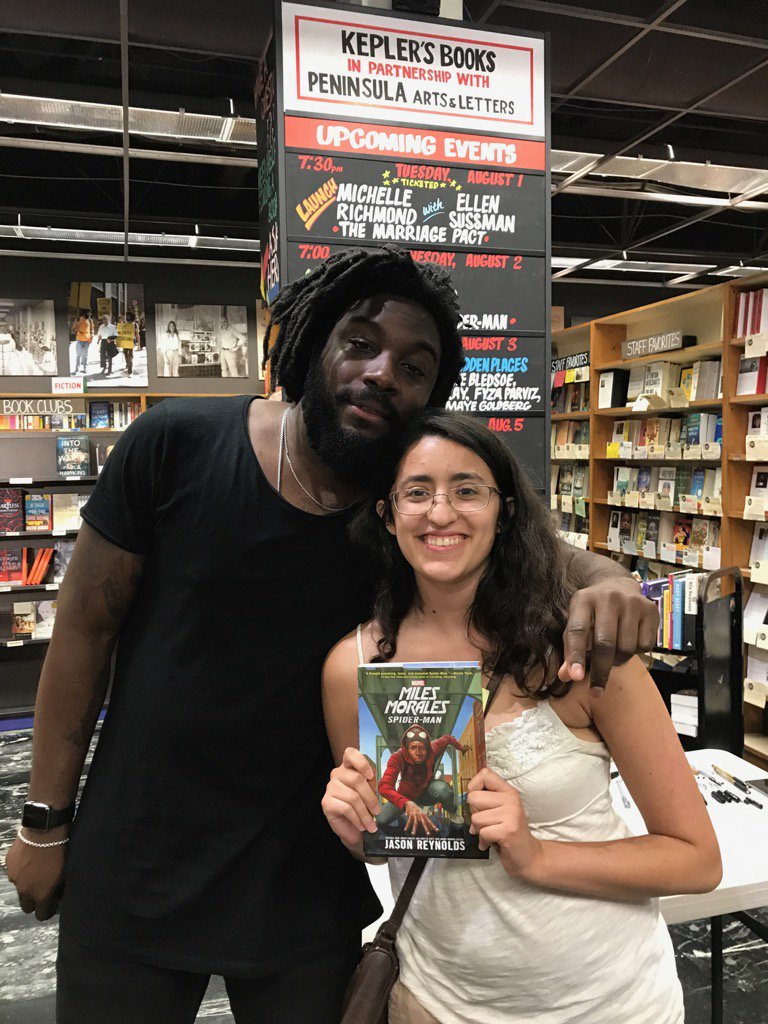
Jason Reynolds & Miles Morales
When Jason Reynolds' agent called him about writing a book about Miles Morales, the first thing he said was: "Never heard of him." "He's a Spider-Man in Brooklyn who's black and Puerto Rican," she explained. He paused. "Continue..."
Throughout his work, Reynolds has written with the intention to teach young boys of color how to become men, so it made sense for him to have an instant interest in writing a YA novel for Miles. That and it's Marvel. There was just one small request from Disney: that he write the book in twenty-eight days. He had to cut himself off from the world to do it, but he succeeded in weaving a narrative that may have a keener awareness for Miles than even the comic books did.
If you haven't read Miles Morales: Spider-Man, the quick run down is that Miles' spidey sense is on the fritz and he's just been suspended from his private school for constantly leaving to "go to the bathroom." This causes tension with his family, particularly his father, who is adamant that Miles doesn't fall into the same criminal habits as his uncle.
When Reynolds kicked off the release of Miles Morales: Spider-Man at an indie bookstore (which was fitting since he's the 2017 Indies First Spokesperson), he talked about the hiccups in the character's comic book background that he had to address. "His father's name is Jefferson Davis, first of all," he said, pausing to let the audience absorb this. Miles Morales, an Afro-Puerto Rican teenager/superhero, has a black father named after the president of the Confederacy. Uh-oh.
"Then I realized that Ganke is Korean but that's not a Korean name," Reynolds continued. "And if Miles' mother is Puerto Rican, she's probably - speaking generally here - she's probably Catholic and would change her name. So why does Miles have her last name?" In the book, Miles explains that his father and uncle made Davis a bad name back in the day, so that was why he goes by Morales. The characters acknowledge the strangeness of other two name problems later in the book, though they can't give an answer to them.
As for the Peter Parker Spider-Man, Reynolds always thought the famous line "With great power comes great responsibility" sounded silly in a fifteen-year-old mouth. "If I got powers, I'd be thinking a whole lot of other things first," said Reynolds. He expressed his interest in expanding Miles' identity as a superhero of color who does not automatically have the same privileges as the likes of Peter Parker. How could Miles be saving the world when his own neighborhood needed saving?
In the novel, Reynolds explores the "survivor's guilt" that Miles feels not only for making it to a private school but also gaining supposedly undeserved powers. When his spidey sense goes out of wack, Miles repeatedly wonders if his time has a hero has run out. If he'll inevitably go back to the hustling in his veins. Miles' conflict sharpens whenever he has a conversation with his father, who had narrowly escaped Uncle Aaron's fate by turning his life around in his youth and who repeatedly emphasizes that he is Miles Morales' father, not Spider-Man's.
Over and over Miles hears the words "You're just like me" in his nightmares, in his day-to-day life, everywhere. He hears the warning that he will turn out just like his uncle. Like how every other brown kid is expected to turn out. It's the fear that plagues real kids like Miles who made it into the good school to help them get out of their rough neighborhood, only to be thrown into the school to prison pipeline as they experience harsher discipline than their white peers.
"It has to matter that he's black and Puerto Rican, " said Reynolds. And he does make it matter. When you realize what Miles is up against in the book, you know that it's intertwined with his racial identity and family roots. Miles' reality is harder because of his skin color. The book makes no qualms about acknowledging that and does not neatly resolve Miles' problems. As a result, the novel's last scene reverberates with a power that only an author like Reynolds could pull off.
As if Reynolds hadn't already won me over enough, he also discussed his mission to deconstruct toxic masculinity in his writing. "In my stories, I have a brown boy who is terrified," said Reynolds. In Miles Morales: Spider-Man, Miles' crush calls him out on his fear. Reynolds also talked about an alternate narrative of men fumbling like nervous wrecks instead of boasting about their womanizing ways. Reynolds illustrates such a narrative when Miles' father tells Miles that he spilled salsa all over his mother when they first met and that Miles should go ahead and "spill the salsa" on his crush. It's a more lighthearted refrain in the novel, but no less powerful in showing a different way to be a man.
If none of that is enough to convince you that Miles Morales: Spider-Man is worth reading, I don't know what to do with you. But if you have any interest in Miles as a character or in Reynolds' mission as a writer, I highly recommend you go to the closest indie bookstore and buy a copy ASAP.
Throughout his work, Reynolds has written with the intention to teach young boys of color how to become men, so it made sense for him to have an instant interest in writing a YA novel for Miles. That and it's Marvel. There was just one small request from Disney: that he write the book in twenty-eight days. He had to cut himself off from the world to do it, but he succeeded in weaving a narrative that may have a keener awareness for Miles than even the comic books did.
If you haven't read Miles Morales: Spider-Man, the quick run down is that Miles' spidey sense is on the fritz and he's just been suspended from his private school for constantly leaving to "go to the bathroom." This causes tension with his family, particularly his father, who is adamant that Miles doesn't fall into the same criminal habits as his uncle.
When Reynolds kicked off the release of Miles Morales: Spider-Man at an indie bookstore (which was fitting since he's the 2017 Indies First Spokesperson), he talked about the hiccups in the character's comic book background that he had to address. "His father's name is Jefferson Davis, first of all," he said, pausing to let the audience absorb this. Miles Morales, an Afro-Puerto Rican teenager/superhero, has a black father named after the president of the Confederacy. Uh-oh.
"Then I realized that Ganke is Korean but that's not a Korean name," Reynolds continued. "And if Miles' mother is Puerto Rican, she's probably - speaking generally here - she's probably Catholic and would change her name. So why does Miles have her last name?" In the book, Miles explains that his father and uncle made Davis a bad name back in the day, so that was why he goes by Morales. The characters acknowledge the strangeness of other two name problems later in the book, though they can't give an answer to them.
As for the Peter Parker Spider-Man, Reynolds always thought the famous line "With great power comes great responsibility" sounded silly in a fifteen-year-old mouth. "If I got powers, I'd be thinking a whole lot of other things first," said Reynolds. He expressed his interest in expanding Miles' identity as a superhero of color who does not automatically have the same privileges as the likes of Peter Parker. How could Miles be saving the world when his own neighborhood needed saving?
In the novel, Reynolds explores the "survivor's guilt" that Miles feels not only for making it to a private school but also gaining supposedly undeserved powers. When his spidey sense goes out of wack, Miles repeatedly wonders if his time has a hero has run out. If he'll inevitably go back to the hustling in his veins. Miles' conflict sharpens whenever he has a conversation with his father, who had narrowly escaped Uncle Aaron's fate by turning his life around in his youth and who repeatedly emphasizes that he is Miles Morales' father, not Spider-Man's.
Over and over Miles hears the words "You're just like me" in his nightmares, in his day-to-day life, everywhere. He hears the warning that he will turn out just like his uncle. Like how every other brown kid is expected to turn out. It's the fear that plagues real kids like Miles who made it into the good school to help them get out of their rough neighborhood, only to be thrown into the school to prison pipeline as they experience harsher discipline than their white peers.
"It has to matter that he's black and Puerto Rican, " said Reynolds. And he does make it matter. When you realize what Miles is up against in the book, you know that it's intertwined with his racial identity and family roots. Miles' reality is harder because of his skin color. The book makes no qualms about acknowledging that and does not neatly resolve Miles' problems. As a result, the novel's last scene reverberates with a power that only an author like Reynolds could pull off.
As if Reynolds hadn't already won me over enough, he also discussed his mission to deconstruct toxic masculinity in his writing. "In my stories, I have a brown boy who is terrified," said Reynolds. In Miles Morales: Spider-Man, Miles' crush calls him out on his fear. Reynolds also talked about an alternate narrative of men fumbling like nervous wrecks instead of boasting about their womanizing ways. Reynolds illustrates such a narrative when Miles' father tells Miles that he spilled salsa all over his mother when they first met and that Miles should go ahead and "spill the salsa" on his crush. It's a more lighthearted refrain in the novel, but no less powerful in showing a different way to be a man.
If none of that is enough to convince you that Miles Morales: Spider-Man is worth reading, I don't know what to do with you. But if you have any interest in Miles as a character or in Reynolds' mission as a writer, I highly recommend you go to the closest indie bookstore and buy a copy ASAP.
Me and Jason Reynolds at Kepler's Books
Wednesday, July 19, 2017
New Spider-Man Accurately Shows the Awkward Stage of a Superhero
Prepare to feel way better about your embarrassing teen years, thanks to the newest Spider-Man. We’ve anticipated the third reincarnation of Spidey ever since his appearance in Captain America: Civil War, and, let’s be honest, we were real nervous about it. However, Marvel answered our concerns with a surprisingly fresh take that shows a Spider-Man in transition. I’m not just talking about the typical arc of an impatient young guy who learns from his mistakes and finds his “inner strength” and whatnot (though that’s definitely there). I’m talking basic, practical, visceral teenage-hero awkwardness.
Let’s start with this: the costume change. Deadpool gets the credit for first pointing out the cumbersome costume change that every other superhero film skips over, but Spider-Man also tackles the challenge in an alleyway as he struggles to shimmy into his costume. (You’d think that Stark would have figured out a way to make that easier.) Worse yet, he loses his backpack afterward. While Deadpool’s costume change intends to satirize, Spider-Man’s simply portrays the less graceful side of a superhero-in-training. This is a Spider-Man who tumbles through backyard bushes, falls from rooftops, and crashes into pools. This is a Spider-Man who stumbles over everything and apologizes profusely as he’s doing it. He’s not the smooth, wisecracking web-slinger that we have seen in the comics. At least not yet. And that’s the cool thing about Spider-Man: Homecoming. It shows us what Peter Parker was probably like when he first started out.
We had a taste of Peter's youthful excitement in Civil War, but apparently it was more extensive than we thought. Homecoming reveals that Peter was taking behind-the-scenes video footage from the moment Tony recruited him to seconds before Peter was called into duty at the airport battle and beyond. His curiosity and enthusiasm is endearing, and it makes so much sense for Peter to feel that way. He’s young, and he wants to save the world as soon as possible. Even my best friend, who’s a hardcore fan of Spider-Man, hadn’t seen this happy-go-lucky version of Peter before. He’s silly in the best possible way.
The movie never lets us forget that Peter’s a sophomore in high school. All the tropes are there to remind us of our own high school days. Unrequited crush. Invited to the cool kids’ party. Homecoming gone wrong. Peter’s best friend Ned also provides a fun dynamic. On one hand he’s the confidant that reminds Peter that “you are a kid” as Peter gripes about Tony treating him like a child. On the other hand he’s asking if Peter can lay eggs and summon a legion of spiders. Boy, please. Summoning insects is Ant-Man’s job.
Thankfully, Tony doesn’t dominate the movie like I was afraid he would. Peter obviously aches for a father figure in Tony (I could think of better role models, honestly, but that’s a post for another time). Tony pops in just often enough for the “fatherly” arc to make sense while still letting Peter come to his own conclusions and find his own path, which creates a nice coming-of-age narrative that we haven’t seen in the MCU yet. Not only was Spider-Man: Homecoming a new, interesting take on Peter Parker, but also on Marvel movies as a whole. I happily welcome the new Spider-Man, and I look forward to seeing the other ways that he develops in future films.
Let’s start with this: the costume change. Deadpool gets the credit for first pointing out the cumbersome costume change that every other superhero film skips over, but Spider-Man also tackles the challenge in an alleyway as he struggles to shimmy into his costume. (You’d think that Stark would have figured out a way to make that easier.) Worse yet, he loses his backpack afterward. While Deadpool’s costume change intends to satirize, Spider-Man’s simply portrays the less graceful side of a superhero-in-training. This is a Spider-Man who tumbles through backyard bushes, falls from rooftops, and crashes into pools. This is a Spider-Man who stumbles over everything and apologizes profusely as he’s doing it. He’s not the smooth, wisecracking web-slinger that we have seen in the comics. At least not yet. And that’s the cool thing about Spider-Man: Homecoming. It shows us what Peter Parker was probably like when he first started out.
 |
Usually I put the movie poster here, but that's a Photoshop disaster so this is a picture of me at the theater instead
|
The movie never lets us forget that Peter’s a sophomore in high school. All the tropes are there to remind us of our own high school days. Unrequited crush. Invited to the cool kids’ party. Homecoming gone wrong. Peter’s best friend Ned also provides a fun dynamic. On one hand he’s the confidant that reminds Peter that “you are a kid” as Peter gripes about Tony treating him like a child. On the other hand he’s asking if Peter can lay eggs and summon a legion of spiders. Boy, please. Summoning insects is Ant-Man’s job.
Thankfully, Tony doesn’t dominate the movie like I was afraid he would. Peter obviously aches for a father figure in Tony (I could think of better role models, honestly, but that’s a post for another time). Tony pops in just often enough for the “fatherly” arc to make sense while still letting Peter come to his own conclusions and find his own path, which creates a nice coming-of-age narrative that we haven’t seen in the MCU yet. Not only was Spider-Man: Homecoming a new, interesting take on Peter Parker, but also on Marvel movies as a whole. I happily welcome the new Spider-Man, and I look forward to seeing the other ways that he develops in future films.
Monday, July 3, 2017
Ahsoka: A Star Wars Story
For fans of the animated series Star Wars: The Clone Wars, E.K. Johnston’s novel Ahsoka is required reading. In the TV series, we saw Ahsoka Tano transform from the brash and sassy Padawan, to the experienced young general, to the Jedi who left the Order after a loss of faith. Johnston continues the Ahsoka character arc we deserved in the tragically cancelled Clone Wars. Ahsoka, who was already struggling to find her new place in the world, has become even more untethered now that most of the Jedi have been wiped out and she can no longer sense her former masters.
Ahsoka spends most of the novel on a moon called Raada in the outskirts of the galaxy, where she meets a small, quiet community of farmers - including a young woman named Kaeden. I assume Kaeden is a black woman from the description of her skin color and hair, but what I know for sure is that Kaeden is the first (confirmed) gay character that I’ve come across in the Star Wars universe. Kaeden’s unrequited feelings for Ahsoka are obvious to everyone except Ahsoka - which is unfortunate, but perhaps for the better since the Star Wars universe has not proven to be relationship-friendly. Meanwhile, the Empire starts to wreak havoc on Raada, and Ahsoka has to navigate her secret identity and her desire to help people. I liked getting inside Ahsoka’s head in a way that I never got to while watching her in The Clone Wars. Because I was reading a novel, I could see her in her tactical mode, her meditations, and her moments of vulnerability in a more intimate setting.
I love how Ahsoka has come into her own in this novel. She’s always had a strong tactical mind and sense of empathy, traits that she has had to sharpen without the guidance of Anakin or Obi-Wan. However, she seems to have achieved a balance and control that Anakin never could. Ahsoka keeps her emotions in check when she is strategizing for her survival or for a mission, but she allows her loyalty and emotional ties to her friends motivate her to save them despite personal risk. She’s taken the best of Anakin’s heart and Obi-Wan’s mind to become a tempered, quick-thinking, and compassionate fighter under pressure. It hurts to see how much she misses them. But if nothing else, they trained her well.
The novel is interspersed with flashbacks, mostly from Ahsoka but also from Anakin and Obi-Wan. All of them will make you sad. If you’re a masochist like me and want to increase your suffering, linger on the first flashback from Ahsoka featuring the old nickname “Snips” or, even worse, the flashback from Anakin: “Anakin had never put in for a Padawan of his own. He didn’t want it to look like he was pushing Obi-Wan aside. Now, Obi-Wan had gone and done it first, and Anakin still wasn’t sure how he felt about it.” THESE ARE NOT THE TEARS YOU’RE LOOKING FOR. *sniffle*
During The Clone Wars, Anakin and Obi-Wan were like Ahsoka’s bickering adopted dads. If you don’t believe me, check the Tumblr memes. If you don’t believe the memes, check the scene where Kaeden's sister asks Ahsoka if her “adopted parents” ever fought and tell me if Ahsoka’s smile doesn’t crush your heart into itty bitty pieces. The Jedi could talk all they wanted about no attachments, but when you’re Anakin Skywalker’s Padawan, there’s no avoiding them. Ahsoka’s feelings about the ones she left behind paint the novel with a tender grief that heightens the tragedy in her life as well as Anakin’s and Obi-Wan’s lives. Now, I don’t want to imply that Ahsoka merely serves as a boost for their story, because that would reduce her character to a prop, and anyone who’s familiar with her character will now that’s not who she is. But their stories have always been and always will be intertwined. Ahsoka allowed us to see the prequel trilogy's universe in a different light. Hopefully, her presence in Star Wars Rebels and other Star Wars installments can help us see the original trilogy’s universe in a different light, too.
The best part of this book is that even after finishing it, I know Ahsoka’s story is not finished. She’s not a Jedi. She’s still figuring out what she will be instead. And if anyone can relate to that, it’s a recent college graduate who has no job and no idea what she’s going to do with her life now that she’s not a student. (Hint: that’s me.) I think a lot of people can relate to her storyline, whether they’re having a mid-life crisis, a quarter-life crisis, or any other identity crisis. Ahsoka shows us that even when you’re forging your own path, it’s okay to acknowledge what the past has done for you, and it’s okay to let go of that past. One day at a time.

 |
| (Source: Wikipedia) |
I love how Ahsoka has come into her own in this novel. She’s always had a strong tactical mind and sense of empathy, traits that she has had to sharpen without the guidance of Anakin or Obi-Wan. However, she seems to have achieved a balance and control that Anakin never could. Ahsoka keeps her emotions in check when she is strategizing for her survival or for a mission, but she allows her loyalty and emotional ties to her friends motivate her to save them despite personal risk. She’s taken the best of Anakin’s heart and Obi-Wan’s mind to become a tempered, quick-thinking, and compassionate fighter under pressure. It hurts to see how much she misses them. But if nothing else, they trained her well.
 |
| Ahsoka leaves the Jedi Order (Source: StarWars.com) |
During The Clone Wars, Anakin and Obi-Wan were like Ahsoka’s bickering adopted dads. If you don’t believe me, check the Tumblr memes. If you don’t believe the memes, check the scene where Kaeden's sister asks Ahsoka if her “adopted parents” ever fought and tell me if Ahsoka’s smile doesn’t crush your heart into itty bitty pieces. The Jedi could talk all they wanted about no attachments, but when you’re Anakin Skywalker’s Padawan, there’s no avoiding them. Ahsoka’s feelings about the ones she left behind paint the novel with a tender grief that heightens the tragedy in her life as well as Anakin’s and Obi-Wan’s lives. Now, I don’t want to imply that Ahsoka merely serves as a boost for their story, because that would reduce her character to a prop, and anyone who’s familiar with her character will now that’s not who she is. But their stories have always been and always will be intertwined. Ahsoka allowed us to see the prequel trilogy's universe in a different light. Hopefully, her presence in Star Wars Rebels and other Star Wars installments can help us see the original trilogy’s universe in a different light, too.
The best part of this book is that even after finishing it, I know Ahsoka’s story is not finished. She’s not a Jedi. She’s still figuring out what she will be instead. And if anyone can relate to that, it’s a recent college graduate who has no job and no idea what she’s going to do with her life now that she’s not a student. (Hint: that’s me.) I think a lot of people can relate to her storyline, whether they’re having a mid-life crisis, a quarter-life crisis, or any other identity crisis. Ahsoka shows us that even when you’re forging your own path, it’s okay to acknowledge what the past has done for you, and it’s okay to let go of that past. One day at a time.

Sunday, July 2, 2017
Miss Peregrine's Home for Peculiar Children
When I watched Tim Burton’s film Miss Peregrine’s Home for Peculiar Children, I knew not to expect the book. I’m glad that I didn’t. I could appreciate the movie for what it was rather than what it wasn’t, while I also pulled out the parallels that did exist between the movie and the book. As a result, I ended up liking both in their own right.
Ransom Riggs created a mixed-media book series that combined text with vintage photographs that he obtained from various collectors. He created characters with semi-creepy powers from these semi-creepy photos and fabricated a fascinating nightmarish adventure that killed off characters left and right. Tim Burton, surprisingly, dials back the dark tones in the books quite a bit in his interpretation. He more or less follows the plot of the first book, but he wraps up the story with a neat, happy ending instead of a cliffhanger.
During the movie, I kept my eyes open to appreciate the elements from the book that did come to life, instead of fretting over what didn’t. In return, I could see the peculiar spirit of the book - that feeling of being different, the eternal pause on childhood, and the shock of the fantastical becoming real and scary. The first time I saw a hollowgast in the movie, I got the heebie-jeebies. As much as I did like the book series, I also found the story intense, violent, and creepy compared to my usual fantasy novels. The movie, meanwhile, treats the story with a quirkier and more lighthearted touch. Burton added humor to the characters. I laughed more during the movie than I remember laughing for Riggs’ three books combined.
Also gone in the Burton movie is the plot about Miss Peregrine’s brothers being the ones to create the wight and hollowgast problem in their pursuit of immortality. The oldest brother Caul in particular inspires a peculiar movement, mostly among males, against ymbrynes like Miss Peregrine who keep peculiar children in eternal loops to protect them from the outside world. His followers claim that the powerful ymbrynes, who are all female, infantilize and oppress peculiar people. Riggs makes no hesitation to point out that Caul’s behavior stems from jealousy that his sister is stronger and more powerful than he could ever be. His rhetoric, frankly, reminded me of men’s rights activists. The subtle conversation about gender dynamics in peculiardom was unexpected, particularly from a male author. Unfortunately it becomes lost in the hands of a male director. Granted, I understand why Burton would cut out Caul from the narrative since he stuck to one movie instead of three, but I still feel like he missed an opportunity.
So, how do the book and movie of the peculiar world compare? The answer to that question doesn’t matter as much as the fact that movie-watching is a lot more fun when you aren’t prepared to criticize it from the onset. In the case of Miss Peregrine, I wouldn’t call the movie “worse,” but “different.” In this case, whether you should read the book instead is up what you want. If you want the peculiar feel of the story without going quite as deep or dark, the movie’s the way to go. If you want to dive into the nuance and fearsomeness as well as the gender dynamics of Riggs’ world, the books are your way in. Or maybe you try both because you’ve got a lot of time on your hands. Like me.
Ransom Riggs created a mixed-media book series that combined text with vintage photographs that he obtained from various collectors. He created characters with semi-creepy powers from these semi-creepy photos and fabricated a fascinating nightmarish adventure that killed off characters left and right. Tim Burton, surprisingly, dials back the dark tones in the books quite a bit in his interpretation. He more or less follows the plot of the first book, but he wraps up the story with a neat, happy ending instead of a cliffhanger.
 |
| Source: Wikipedia |
 |
| Just look at the different color schemes between the film poster and book cover to get an idea of what I'm talking about. Source: Wikipedia |
Burton also did two interesting things to the main character Jacob’s love interest. First, Burton downplayed Emma’s relationship with Jacob’s grandfather, making her current romantic involvement with Jacob way less icky. Second, he changed Emma’s power from controlling fire to controlling air. Compared to the book Emma, movie Emma is softer, gentler, less in your grill. She floats on air instead of spitting fire in everyone’s face - which, to be honest, I missed. I couldn’t help but wonder if Burton changed her character because she was too “aggressive” as a female character. If so, he missed the fact that she’s also the most grounded character, believing in Miss Peregrine and in Jacob so steadfastly that she gives the other characters the courage they need to face the horrors around them. She feels deeply, and even though she is confrontational, she is also vulnerable. All of those dimensions are skimmed over or ignored in Burton’s movie. Part of it comes at the price of condensing the story to 100 minutes. The other part comes from Burton’s different sensibilities. I liked picking out the differences between the Emma’s, weighing the good and bad in both versions and thinking about what I value most in a female character. I’ll be honest though, even if I miss the fire, that movie scene where Emma blasts water out of an entire submerged ship with just her lung power was pretty amazing. Definitely not in the book.
Also gone in the Burton movie is the plot about Miss Peregrine’s brothers being the ones to create the wight and hollowgast problem in their pursuit of immortality. The oldest brother Caul in particular inspires a peculiar movement, mostly among males, against ymbrynes like Miss Peregrine who keep peculiar children in eternal loops to protect them from the outside world. His followers claim that the powerful ymbrynes, who are all female, infantilize and oppress peculiar people. Riggs makes no hesitation to point out that Caul’s behavior stems from jealousy that his sister is stronger and more powerful than he could ever be. His rhetoric, frankly, reminded me of men’s rights activists. The subtle conversation about gender dynamics in peculiardom was unexpected, particularly from a male author. Unfortunately it becomes lost in the hands of a male director. Granted, I understand why Burton would cut out Caul from the narrative since he stuck to one movie instead of three, but I still feel like he missed an opportunity.
So, how do the book and movie of the peculiar world compare? The answer to that question doesn’t matter as much as the fact that movie-watching is a lot more fun when you aren’t prepared to criticize it from the onset. In the case of Miss Peregrine, I wouldn’t call the movie “worse,” but “different.” In this case, whether you should read the book instead is up what you want. If you want the peculiar feel of the story without going quite as deep or dark, the movie’s the way to go. If you want to dive into the nuance and fearsomeness as well as the gender dynamics of Riggs’ world, the books are your way in. Or maybe you try both because you’ve got a lot of time on your hands. Like me.
Sunday, June 4, 2017
Wonder Woman Slays the Day
SPOILER ALERT: Wonder Woman gets a rude awakening.
Make no mistake that Wonder Woman is better than everyone. *glares at Batman and Superman* I find delicious satisfaction in that DC finally found its big break in what the LA Times calls "the first female-fronted superhero blockbuster," with Wonder Woman grossing $100.5 million in its debut weekend. DC can finally heave a sigh of relief. Fourth, fifth, sixth time's the charm.
There's a certain coming-of-age quality to Wonder Woman's origin story. She grew up in paradise filled with strong women like her mother Hippolyta, who instilled the values of justice and peace-keeping through stories of the Amazonian past. Wonder Woman, also known as Diana, then steamrolls alongside Allied spy Steve Trevor into a war-torn world. She's determined to slay Ares the god of war, because she believes his influence is the sole reason for the war and that once he is dead, then everyone will stop fighting and killing each other. Take out the one bad guy, and you're all good, right? It takes a while for Diana to learn what we already know: people are way more complicated.

(Source: Wikipedia)
Besides the nice character development, the film has great action scenes, with liberal use of the dramatic slo-mo and athletic feats that would make you do a double take. Wonder Woman is a goddess. Meanwhile, Steve does his best to help with his rifle, with a pew-pew here and a pew-pew there, but you know she's the one that's kicking butt and taking names.
I also like that the movie acknowledges racism several times through Sameer and Chief, two men of color on Wonder Woman's team. Sameer wanted to be an actor, but he tells her that the color of his skin has ultimately forced him to become a spy instead. Chief, a Native American, explains that when he smuggles, he's taking back what was taken from his people by (gesturing to Steve) "his people." Both Sameer and Chief become heroes in their own right, and I appreciated seeing that.
Wonder Woman showed us the transformation of an idealistic, fresh-faced woman into a hardened warrior that knows her way with a sword (a sword, mind you, that at one point she wears in the back of her dress). The film made me gasp with surprise and tear up with emotion. Diana and her merry band of unexpected heroes are a wonderful (pun not intended) addition to the DCEU. This world did not deserve this movie. But I'm sure glad that we got it.
P.S. There's a big spoiler that's not in the header. Can you guess what it is?
Wednesday, May 24, 2017
Everything, Everything
SPOILER ALERT: Rapunzel leaves her tower.
Imaginative and sweetly tender, Everything, Everything is a young adult romance that fulfills your feel-good needs thanks to the performance of its talented leads. The movie follows Maddy, a girl who has stayed inside her house her whole life because she has a compromised immune system - SCID, which she illustrates for us in the opening. Then along comes the new neighbor Olly with a bundt cake and... well, you get the idea.
I thought the movie stayed true to the YA fiction genre it came from. The characters felt like real teenagers. Their story felt hopeful and cutesy and touching. Example: when Olly and Maddy finally meet in person, you see subtitles of their thoughts as they awkwardly try to make conversation. Olly: I'm more nervous than she is and she's never even left the house! Maddy: His hair could save my life. Funniest scene in the whole movie.
Beneath my sarcastic exterior is a giant cheeseball for a heart, and that heart bawled ugly happy tears for this movie. The actors have wonderful onscreen chemistry and a fun, flirty friendship that develops into something bold and genuine as the story progresses. The pièce de résistance is that it's a relationship between a white guy and black girl that NO ONE questions on the basis of their race. I need me more healthy interracial relationships like this.
Beneath my sarcastic exterior is a giant cheeseball for a heart, and that heart bawled ugly happy tears for this movie. The actors have wonderful onscreen chemistry and a fun, flirty friendship that develops into something bold and genuine as the story progresses. The pièce de résistance is that it's a relationship between a white guy and black girl that NO ONE questions on the basis of their race. I need me more healthy interracial relationships like this.

(Source: Wikipedia)
Since Maddy takes architectural classes, she frequently builds models of various structures - including a 50s diner and a several-story library that she visualizes meeting Olly in as they are having their text conversations. I loved seeing those imagined architectural spaces on screen that allow Maddy to touch and talk to Olly in a personal interaction that she desperately desires. In and out of those spaces walks the astronaut that Maddy also puts into every model because she identifies with a man in a suit in space. That aspect of the film was fascinating both visually and metaphorically for me.
The movie had its faults, which my mother and I discussed afterward. Maddy's nurse Carla has a daughter, Rosa, who is briefly introduced at the beginning but does not return until the end. We thought it would have made more sense to include more of Rosa and to have her facilitate Olly meeting Maddy at her house rather than Carla, since a teenager is more likely to take risk like that. I also thought that we should have seen hints earlier on about Maddy's mother being controlling and overprotective of her daughter, which doesn't come to a head until the last minute.
I mentioned to my mother that I saw a lower rating for Everything, Everything on Rotten Tomatoes, and she said: "It's very much a girl movie. Probably it was all the male reviewers who said bad things." I haven't checked to see if her comment is true, but it's probably true in the sense that anyone who is not into somewhat sappy teenager romance won't have much interest in this movie. If that's not your style, it's not your style. But if it IS your style, I think watching it is worth your while.
P.S. I totally stole the idea of a spoiler header from Maddy. She writes several blog reviews throughout the movie and always puts a funny or cryptic spoiler at the top. Might try doing that from now on.
Wednesday, May 10, 2017
Guardians of the Galaxy Volume 2
I try not to be Marvel trash. I really do. You would think that I'd get bored of Marvel after six or seven years, but somehow the Guardians have won me over for the millionth time. The sequel to last year's smash hit, though not quite up to par with the original, was still funny, still zany, and still hard on the feels. Sue me, I liked it.

I will say that some of the humor fell flat this time around. The movie takes shots at a few cheap jokes and of course that means that not all of them are going to get a laugh. It's not the end of the world and it doesn't take away from the overall comedy and feel-good vibes, but I have to acknowledge it. Aside from that, the movie had stunning space fight visuals, unexpected emotion that made me tear up at least once, and a fun comedic tone that I enjoyed thoroughly. And I hope to keep enjoying the Guardians for several years to come.

(Source: Wikipedia)
Peter, Gamora, Drax, Rocket, and Groot are back to save the day. In true Guardians fashion, one of the first scenes opens with the gang fighting a disgusting monster as baby Groot jams to the first song he plays on Peter's Awesome Mixtape Vol. 2. Rocket reveals afterward that he has stolen the very batteries that they were protecting from the monster, and as a result the people who hired them chase the Guardians throughout the movie to get them back. But that's not the main story. The big reveal is when Peter Quill's father Ego (played by Kurt Russell) arrives to bond with his long-lost son and takes them to the planet that he created with his Celestial powers. I won't go too much into the Peter-Ego relationship because (SPOILER), but just know my mind was blown by Ego's character several times.
In line with the father-son theme, Rocket is constantly struggling with the burden of fatherhood - namely making sure that Groot doesn't get them all killed. Wonderful and hilarious interactions ensue. Meanwhile, Yondu, who Ego had hired to take Peter to him after his mother died, has been kicked out of the Ravagers for breaking their code and feels lost until he runs into Rocket. They come to realize that they have more common than they think, and it's an excellent moment for both characters. I didn't expect Yondu of all people to get me so emotional on several occasions, especially because of how crappy he was to Peter in the first movie, but he does. And that whistling arrow is as cool as ever.
Nebula, Gamora's sister, is trying to kill her for revenge for always beating her when their father Thanos would pit them against each other. She gives us another hint at how awful Thanos is and reveals a surprising dynamic between her and Gamora that I hope to see developed more in the future. Drax is still not doing much, like last time, but I did love his interactions with Mantis, an alien who can feel people's feelings by touching them. He's so blunt and she's so innocent and it makes an interesting contrast.
One of my favorite moments in the film is when Gamora mentions how Peter told her that he used to carry a picture of David Hasselhoff and tell other kids that it was his father. Peter complains that he told her that when he was drunk and it's too depressing, but Gamora replies, "I love that story." Ever since the first movie, Peter has had an obvious crush on Gamora and tries to flirt with her, but she shoots him down every time. However, their conversation about Peter's childhood story reveals that if Peter stopped acting so cocky and shared more vulnerably with Gamora, she would probably be far more receptive to his romantic intentions. The moment subtly shows men that being tough and egotistical isn't the way to win women over. (Certainly not this woman, anyway.)
I will say that some of the humor fell flat this time around. The movie takes shots at a few cheap jokes and of course that means that not all of them are going to get a laugh. It's not the end of the world and it doesn't take away from the overall comedy and feel-good vibes, but I have to acknowledge it. Aside from that, the movie had stunning space fight visuals, unexpected emotion that made me tear up at least once, and a fun comedic tone that I enjoyed thoroughly. And I hope to keep enjoying the Guardians for several years to come.
 |
| The Marvel Trash Can. This is where I am, and this is where I'll stay. (Source: Wikipedia) |
Monday, March 13, 2017
Orale, Zoot Suit!
Minutes before the show began, the closed curtain looked like a giant newspaper with the title "WAR EXTRA: American Bomber Victim of Jap Raider" and several other headlines, including: "Grand Jury to Act in Zoot Suit War." When the lights faded to black, a silver blade jutted out and ripped the middle of the curtain, trailing down to the bottom in rhythm with the snappy music that started to play. A zoot suit pant leg stretched out of the hole like a lady's leg in a black stocking stretching out from behind the red curtain. The crowd rumbled. Finally, the mustached zoot suiter stepped out from the curtain and leaned so far back he was almost lying down, and the crowd cheered. It was El Pachuco.

Luis Valdez's 1978 hit show Zoot Suit had returned to the stage, telling the story of Henry Reyna and the infamous historical Sleepy Lagoon murder trial that wrongfully imprisoned a group of Mexican American youths. As Henry transitions from a starry-eyed, soon-to-be Navy man to an embittered prisoner, his El Pachuco conscience follows him to remind him that "America is not your country" and to break the fourth wall to the audience in his throaty, drawling voice. The Pachuco periodically breaks into song with his trio of pachuco girls and an impressive choreography with the rest of the cast. He and the other characters throw in Spanish, English, and the pachuco dialect throughout, which is great to express the culture, but for pochas like me it makes it harder to catch all the jokes. I only have my two-year-old self to blame for refusing to learn Spanish from my mother.
I loved all the subtle ways the play hinted at the ties between the Jewish and Chicano experience during World War II. Through Henry's interactions with Jewish activist Alice Bloomfield, the Pachuco's offhand comment that Chicanos were fighting Nazis at home, or the music sequence where the pachuco girls step out in red dresses and black hats - the play shows no qualms in tearing down America's idealized image of itself as the savior of WWII. There's also a religious parallel in the Pachuco figure. During the Zoot Suit Riots, navy officers are stripping Mexicans of their zoot suits, so the Pachuco pushes the other characters aside to take the brunt. When the officers finish with him, he falls to the floor wearing only a loin cloth, a Christ-like martyr representing the death of the Chicano spirit. However, it's not long before the Pachuco rises again in a pristine white zoot suit to greet Henry.
I'm sure you can tell, but the Pachuco steals the show. Some of the best moments and most biting lines come from him - particularly during his fourth wall breaks. When Henry is tempted to kill the rival Downey gang member in a brawl, the Pachuco stops him to point out the audience, who has apparently paid good money to watch him kill somebody. Henry refrains. For the first of the play's alternate endings, the LA Times character claims Henry did go on to kill a fellow prisoner, but the Pachuco interrupts "That's what you'd like to think," before presenting two other possible endings where Henry becomes a war hero and a family man. The play invites the audience to make what they will of the story, a fascinating ambiguity that fiddles with history and fiction, pessimism and hope.
The show will go on until April 2, 2017, but hurry if you're thinking of buying a ticket! If they're not too hella expensive by now. There's a film version out there too that you can consider watching if that's the case.

Us Mexicans we dress dapper, ese.
Luis Valdez's 1978 hit show Zoot Suit had returned to the stage, telling the story of Henry Reyna and the infamous historical Sleepy Lagoon murder trial that wrongfully imprisoned a group of Mexican American youths. As Henry transitions from a starry-eyed, soon-to-be Navy man to an embittered prisoner, his El Pachuco conscience follows him to remind him that "America is not your country" and to break the fourth wall to the audience in his throaty, drawling voice. The Pachuco periodically breaks into song with his trio of pachuco girls and an impressive choreography with the rest of the cast. He and the other characters throw in Spanish, English, and the pachuco dialect throughout, which is great to express the culture, but for pochas like me it makes it harder to catch all the jokes. I only have my two-year-old self to blame for refusing to learn Spanish from my mother.
I loved all the subtle ways the play hinted at the ties between the Jewish and Chicano experience during World War II. Through Henry's interactions with Jewish activist Alice Bloomfield, the Pachuco's offhand comment that Chicanos were fighting Nazis at home, or the music sequence where the pachuco girls step out in red dresses and black hats - the play shows no qualms in tearing down America's idealized image of itself as the savior of WWII. There's also a religious parallel in the Pachuco figure. During the Zoot Suit Riots, navy officers are stripping Mexicans of their zoot suits, so the Pachuco pushes the other characters aside to take the brunt. When the officers finish with him, he falls to the floor wearing only a loin cloth, a Christ-like martyr representing the death of the Chicano spirit. However, it's not long before the Pachuco rises again in a pristine white zoot suit to greet Henry.
I'm sure you can tell, but the Pachuco steals the show. Some of the best moments and most biting lines come from him - particularly during his fourth wall breaks. When Henry is tempted to kill the rival Downey gang member in a brawl, the Pachuco stops him to point out the audience, who has apparently paid good money to watch him kill somebody. Henry refrains. For the first of the play's alternate endings, the LA Times character claims Henry did go on to kill a fellow prisoner, but the Pachuco interrupts "That's what you'd like to think," before presenting two other possible endings where Henry becomes a war hero and a family man. The play invites the audience to make what they will of the story, a fascinating ambiguity that fiddles with history and fiction, pessimism and hope.
The show will go on until April 2, 2017, but hurry if you're thinking of buying a ticket! If they're not too hella expensive by now. There's a film version out there too that you can consider watching if that's the case.
Sunday, February 26, 2017
Groupon
This is a sponsored post. Hopefully for something you'll find useful! All opinions are mine.
When I think of coupons, I have an image of a middle-aged soccer mom throwing them at a grocery store cashier so she’ll get $2 off her 2% milk. It turns out that there’s a lot more to coupons. On my first visit to Groupon’s website, I was surprised at their diversity of offers, from electronic goods to yoga classes to local eateries to sports games, and I discovered deals that were right in my area.
Up to 50% off at ZPizza in Claremont. 38% off a OneRepublic concert in Anaheim. 46% off admission for two to the American Museum of Ceramic Art in Pomona. The cool thing about the Groupon mobile app (which is free!) is that you can look up local deals on the spot when you’re taking a night on the town and you’re deciding where to go for food or fun.

A few clicks on Groupon and you’ll find hundreds of coupons for big name stores and corporations, such as eBay. We all know you can literally buy anything on eBay. They have 12 subcategories for books alone. Considering what I blog about, I'll also mention Barnes & Noble and Fandango for offering a myriad of coupons and deals on books and movies on Groupon. No longer do you need to cut coupons out of newspapers. They're already right there on your phone or laptop!
One feature I think Groupon could add is allowing users to search by item category under each store (i.e. books, cookware, electronics). If I want to check for coupons for DVDs at Target, for example, I’d like to see that in its own category.
My minor suggestion aside, Groupon makes the coupon experience much more convenient and available for on-the-go shopping. Which is great for lazy people like me. 😆 So next time you’re shopping online or in store, consider Groupon as a new way to save!
When I think of coupons, I have an image of a middle-aged soccer mom throwing them at a grocery store cashier so she’ll get $2 off her 2% milk. It turns out that there’s a lot more to coupons. On my first visit to Groupon’s website, I was surprised at their diversity of offers, from electronic goods to yoga classes to local eateries to sports games, and I discovered deals that were right in my area.
Up to 50% off at ZPizza in Claremont. 38% off a OneRepublic concert in Anaheim. 46% off admission for two to the American Museum of Ceramic Art in Pomona. The cool thing about the Groupon mobile app (which is free!) is that you can look up local deals on the spot when you’re taking a night on the town and you’re deciding where to go for food or fun.

(PC: Paul Swansen)
A few clicks on Groupon and you’ll find hundreds of coupons for big name stores and corporations, such as eBay. We all know you can literally buy anything on eBay. They have 12 subcategories for books alone. Considering what I blog about, I'll also mention Barnes & Noble and Fandango for offering a myriad of coupons and deals on books and movies on Groupon. No longer do you need to cut coupons out of newspapers. They're already right there on your phone or laptop!
One feature I think Groupon could add is allowing users to search by item category under each store (i.e. books, cookware, electronics). If I want to check for coupons for DVDs at Target, for example, I’d like to see that in its own category.
My minor suggestion aside, Groupon makes the coupon experience much more convenient and available for on-the-go shopping. Which is great for lazy people like me. 😆 So next time you’re shopping online or in store, consider Groupon as a new way to save!
Sunday, January 15, 2017
Hidden Figures: Women & STEM Do Mix
Hidden Figures is proof that black women get the job done. Since its first trailer, I have looked forward to seeing the true story about the women behind NASA’s groundbreaking (space-breaking?) expeditions. The film holds nothing back in portraying the subtle and obvious racial discrimination in the 1960s, but it simultaneously enforces the hope that things can get better.

The film revolves around three women - Dorothy, Mary, and Katherine - who work as "computers" for NASA and must fight to step up the professional ladder. Mary struggles to become an engineer, Dorothy a computer programmer. Katherine Goble, the central character, is hired by the space program to check the math for trajectories and launches, a fact that insults hotshot Paul Stratton’s elitist sensibilities. She struggles to justify her presence to her alleged superiors. The character’s (and the film’s) most powerful, racially charged moment stems from something seemingly mundane: a trip to the bathroom. Katherine has to trudge a half mile to the west campus to use the colored ladies’ restroom, a forty-minute long endeavor. We see her do this throughout the movie, until one ridiculously rainy day her boss demands to know why she keeps disappearing. She explodes. She tells him off for all the indignities she has endured, from the bathroom to the “colored” coffee cup that everyone refuses to touch. Such small details, but they build up to a larger injustice. The scene that follows Katherine's explosion is just as great.

Because I appreciated the movie for portraying important historical women and their struggles, I wanted to love the movie unequivocally. However, I do have my criticisms. There were several times where the plot and tension ran a little slow and I started to fidget in my seat. Meanwhile, all of the three characters experience unprecedented victories, becoming the First African American women to do X, Y, and Z. Though I understand the need to end on a happy and hopeful note, I also wonder if ending with complete victories all around gives the impression that our work for racial justice is done. Of course, those women really did succeed in their aspirations, but black people now still have to endure more than their fair share in life.
Though not always possessing the most compelling plot, Hidden Figures does offer sympathetic characters and stellar acting that made me enjoy the film. I believe that Hidden Figures deserves an audience if for no other reason than our sore need for movies to embrace the talent and genius of women of color. Katherine and her colleagues deserve for us to know their historic contribution. They have already been forgotten for long enough.

(Source: Wikipedia)

Katherine Goble Johnson
(Source: Wikipedia)
Because I appreciated the movie for portraying important historical women and their struggles, I wanted to love the movie unequivocally. However, I do have my criticisms. There were several times where the plot and tension ran a little slow and I started to fidget in my seat. Meanwhile, all of the three characters experience unprecedented victories, becoming the First African American women to do X, Y, and Z. Though I understand the need to end on a happy and hopeful note, I also wonder if ending with complete victories all around gives the impression that our work for racial justice is done. Of course, those women really did succeed in their aspirations, but black people now still have to endure more than their fair share in life.
Though not always possessing the most compelling plot, Hidden Figures does offer sympathetic characters and stellar acting that made me enjoy the film. I believe that Hidden Figures deserves an audience if for no other reason than our sore need for movies to embrace the talent and genius of women of color. Katherine and her colleagues deserve for us to know their historic contribution. They have already been forgotten for long enough.
Tuesday, December 20, 2016
Rogue One: The Star Wars Prequel Fans Deserved
Star Wars fans seem to agree on one thing: ignore the prequels. However, fans can rejoice in Rogue One as it blends the new and the old while offering a fantastic space ride and just enough character throwback (or foreshadowing?) to satisfy your all your nerdy needs. The movie tells the story of the people who steal the plans to the Death Star, and despite knowing the end result, I was still invested in every character, every moment. Spoilers ahead.

The protagonist Jyn Erso is the daughter of Galen Erso, who is responsible for the design and construction of the Empire’s Death Star. Galen sends a message through a defected pilot that he has placed a hidden weakness in the weapon. When the Rebellion recruits Jyn for her help, she must convince them of her father’s good intentions and exploit the Death Star’s weakness. We know from the original trilogy that she and the other characters succeed but die in the attempt, since none of them greet Luke Skywalker in A New Hope. Although this could have stolen the tension, it instead creates a ticking time bomb for the characters to operate in.
I liked Jyn as a headlining female character (though not quite as much as Rey). She looks tough, she is tough, but her devotion to her father carries the story as she reveals a greater amount of hope than she initially had. Rebel officer Cassian Andor possesses an interesting moral nuance as a man who believes in the cause but who has done pretty ugly things to support that cause. Then there are just plain cool characters such as Chirrut Imwe, a blind warrior who taps into the Force to kick everyone’s ass and take names - though he isn’t himself a Jedi. His capabilities reminded me of Toph Beifong from Avatar: The Last Airbender. K-2SO, a former imperial android, was by far the sassiest character. He had the best lines. I didn’t think I would find a droid the most relatable character, but here we are.
Meanwhile, Saw Gerrera wasn’t used much despite his important relationship to Jyn. After her father was kidnapped, Gerrera rescued and raised Jyn until she was sixteen and he abandoned her to “protect” her - a fact that was skimmed over in a fast and awkward conversation. I guess you can only cover so much, but I would rather not be set up to believe a character is more significant than he is if he’s only going to fall away in the first act.
The movie quickly establishes that Galen Erso is an unwilling accomplice to the Empire’s Death Star, but I thought it missed an opportunity to amp up the moral grayness. One of Jyn’s childhood flashbacks hinted that Galen was once willingly working with the Empire. I thought the story could have explored his involvement more and make the audience wonder whether Jyn is right to automatically trust him. But that’s just a thought.
I also want to gush about the diversity of the cast. Almost all of them were people of color, which makes me wonder where they disappeared to in the original trilogy. Even better, Andor is played by Mexican actor Diego Luna. A Mexican in Star Wars! I’m so proud because it means I have a chance.
Rogue One offers a fun and fast-paced space adventure that mixes the appropriate amount of action and just enough fan service to make me squeal at the right moments. I hope that this film signals more quality Star Wars content in the future, from Episode VIII to the Han Solo spin-off to whatever else Disney churns out for us. It’s a good time for geeks to be alive.

(Source: Wikipedia)
The protagonist Jyn Erso is the daughter of Galen Erso, who is responsible for the design and construction of the Empire’s Death Star. Galen sends a message through a defected pilot that he has placed a hidden weakness in the weapon. When the Rebellion recruits Jyn for her help, she must convince them of her father’s good intentions and exploit the Death Star’s weakness. We know from the original trilogy that she and the other characters succeed but die in the attempt, since none of them greet Luke Skywalker in A New Hope. Although this could have stolen the tension, it instead creates a ticking time bomb for the characters to operate in.
I liked Jyn as a headlining female character (though not quite as much as Rey). She looks tough, she is tough, but her devotion to her father carries the story as she reveals a greater amount of hope than she initially had. Rebel officer Cassian Andor possesses an interesting moral nuance as a man who believes in the cause but who has done pretty ugly things to support that cause. Then there are just plain cool characters such as Chirrut Imwe, a blind warrior who taps into the Force to kick everyone’s ass and take names - though he isn’t himself a Jedi. His capabilities reminded me of Toph Beifong from Avatar: The Last Airbender. K-2SO, a former imperial android, was by far the sassiest character. He had the best lines. I didn’t think I would find a droid the most relatable character, but here we are.
Meanwhile, Saw Gerrera wasn’t used much despite his important relationship to Jyn. After her father was kidnapped, Gerrera rescued and raised Jyn until she was sixteen and he abandoned her to “protect” her - a fact that was skimmed over in a fast and awkward conversation. I guess you can only cover so much, but I would rather not be set up to believe a character is more significant than he is if he’s only going to fall away in the first act.
The movie quickly establishes that Galen Erso is an unwilling accomplice to the Empire’s Death Star, but I thought it missed an opportunity to amp up the moral grayness. One of Jyn’s childhood flashbacks hinted that Galen was once willingly working with the Empire. I thought the story could have explored his involvement more and make the audience wonder whether Jyn is right to automatically trust him. But that’s just a thought.
I also want to gush about the diversity of the cast. Almost all of them were people of color, which makes me wonder where they disappeared to in the original trilogy. Even better, Andor is played by Mexican actor Diego Luna. A Mexican in Star Wars! I’m so proud because it means I have a chance.
Rogue One offers a fun and fast-paced space adventure that mixes the appropriate amount of action and just enough fan service to make me squeal at the right moments. I hope that this film signals more quality Star Wars content in the future, from Episode VIII to the Han Solo spin-off to whatever else Disney churns out for us. It’s a good time for geeks to be alive.
Monday, December 12, 2016
Moana Review
Moana is a strong, independent woman who don't need no man. Well, she recruits help from a demigod, but when you watch the movie my point still stands. I consider Moana another Disney hit (as if the box office numbers don't already speak for themselves) that deserves attention for its beauty, its sound, and its heart. Disney has created yet another fun animated film with catchy music, exciting adventure, and rich culture. Real culture. Even though I'm not Polynesian, I saw a lot of myself in Moana's design: dark skin, dark wavy hair, brown eyes. Of course I'm not salty about still waiting for a Latina princess movie. At all. But I can move past that to enjoy myself anyway.

(Source: Wikipedia)
The demigod Maui (voiced by Dwayne "The Rock" Johnson) stole the greenstone heart of island goddess Te Fiti until he was attacked by a lava demon and lost it in the sea. The ocean, personified to be a character of its own, chooses Moana (voiced by Auli'i Cravalho) as a child with the heart of Te Fiti. I question why the ocean would give a toddler such an important object, but her grandmother took good care about it in the meantime so I'll let it go. Moana grows up dreaming of sailing across the ocean, but her father insists she focus on her upcoming role as chief of Montunui. You know how that's going to go. Because Te Fiti's missing heart has caused their island to start deteriorating, Moana must follow the call of the ocean and her seafaring ancestors with the loving support of her grandmother behind her.
Moana has a great dynamic with demigod Maui. They create a comedic duo (with no romantic entanglements!) who eventually form an emotional bond. I give snaps to the movie for keeping me engaged with a story that mostly takes place with just two characters out on the ocean. One of my favorite moments in the film was Moana insisting that she wasn't a princess and Maui replying that if she has a dress and an animal sidekick, she's a princess. Moana is the chief's daughter and will soon be chief herself, but she makes clear that this is not the same as a European concept of a princess. Where was this hilarious meta-commentary during Pocahontas? I was disappointed that Moana's idiotic chicken was the animal sidekick rather than the pig. The pig was way cuter.

(Source: Wikipedia)
Because Disney cannot resist its compulsion to make everything musical, we hear songs from Moana, Maui, and other characters throughout. The soundtrack isn't my favorite of all time, but "How Far I'll Go," "Where You Are," and "We Know the Way" have beautiful vocals and sound. I loved that Polynesian talent went behind writing, producing, and voicing Moana, and that the film explored wayfinding, which is how islanders discovered and planted themselves in every habitable island in the Pacific - a real-life historical phenomenon. However, make no mistake that this movie is not a completely accurate representation of Samoans, Tahitians, Hawaiians, and other distinct peoples that were mashed into one island. Perhaps that's obvious, but if people can believe Africa is a country then I must make this disclaimer. I have seen the conflicted response to Moana - pride in being represented on some level and anger at sacred traditions, clothing, mythology, etc. being appropriated, homogenized, and commodified by Disney. So, what to do with this knowledge?
Moana is a fun and inspiring movie that managed to touch me and surprise me. I think there's nothing wrong with appreciating the film, but I hope it encourages people to learn the real history and customs and peoples behind it. If Moana's success inspires its audience to do so, then it will have done a great service to Polynesians and to the world at large. Education is powerful, friends. And so is Moana. Don't let either go to waste.
Monday, December 5, 2016
Doctor Strange Review
The Marvel formula has succeeded again. The first origin story since Ant-Man, Doctor Strange opens an exciting new dimension of the multiverse: magical mysticism and sorcery. (I watched this on the same day I watched wizardry and witchcraft in Fantastic Beasts. Here's hoping I don't burn in hellfire for the double whammy.) While the film has its issues, from the casting controversy to its formulaic pattern, Doctor Strange still engaged me with stunning visuals and some surprises behind the curtain.

I cannot imagine how hard the special effects team worked to make the film happen. Even without seeing it in 3-D, I was entranced and engulfed by the colorful kaleidoscope world that they created. The new visual and psychological presence of mysticism fascinated me. Meanwhile, although Dr. Strange doesn't offer a wit quite on par with some other Marvel characters, he was good for an occasional laugh. I had no comic book background with the character, so perhaps that's why I was surprised at how much Stephen Strange remind of Tony Stark. For one thing, they have similar facial hair, and they're both arrogant.

(Source: Wikimedia Commons)
I cannot imagine how hard the special effects team worked to make the film happen. Even without seeing it in 3-D, I was entranced and engulfed by the colorful kaleidoscope world that they created. The new visual and psychological presence of mysticism fascinated me. Meanwhile, although Dr. Strange doesn't offer a wit quite on par with some other Marvel characters, he was good for an occasional laugh. I had no comic book background with the character, so perhaps that's why I was surprised at how much Stephen Strange remind of Tony Stark. For one thing, they have similar facial hair, and they're both arrogant.
However, Strange's (excuse me, Doctor Strange's) pride takes an interesting shape. He is an excellent neurosurgeon who saves a person's life in the first scene and has saved many other lives before that, but it turns out he only takes the cases that will make him look good. Near hopeless cases he tosses aside. I have no idea why Pepper Potts - I mean Christine Palmer - puts up with him. A former lover and current colleague of Dr. Strange, Palmer stays by his side when a car accident steals the steadiness of his hands. I liked watching Dr. Strange coming into his own. His arc goes the way you might expect of an initially self-glorifying character who learns to be a hero. We've all seen it before. That's because it works, and it works for this movie.

(Source: Wikimedia Commons)
Her powerful force makes me all the more disappointed about a white woman being cast as her. The original Ancient One was a Tibetan man. The movie creators have given us all kinds of reasons as to why Swinton rather than an Asian actress was cast. The Washington Post does an excellent job breaking down their excuses. I would like to add that the director's fear of an Asian Ancient One becoming a Dragon Lady stereotype wouldn't have happened with the way her character was written and performed. A Dragon Lady is strong, mysterious, domineering, and manipulative. The Ancient One is certainly the first two, but I would hardly describe her as domineering or manipulative. And how wonderful it would have been to see the stereotype of a meek, quiet, shy Asian woman broken with a powerful, complex, wise master of mystic arts. If people automatically label such a thing as "Dragon Lady," that's their prejudice and their problem.
People have a right to be upset about whitewashing in Doctor Strange. If it wasn't for that, I would have no qualms about recommending it. For me, the movie was worth watching to continue following the Marvel Cinematic Universe and be able to see and discuss for myself what is right and what is wrong with Doctor Strange. I hope Marvel has learned their lesson from the controversy. With the talent of their writers, directors, and actors, the studio can and has created three-dimensional characters rather than racist caricatures before. Marvel can afford to take a few risks with other characters of color. Starting with - and I know this is pretty radical - casting an Asian actor for an Asian character. What a concept.
Monday, October 24, 2016
Bad Moms
If I were a mom, I would whip out the duct tape every time my kid talked back to me - which is probably why I'll never be a mom. (You're welcome, non-existent children.) Although, according to the R-rated comedy Bad Moms, even the seemingly perfect moms don't always know how to best handle their kids, or their lives. As the movie creates an atmosphere ripe for laughter and fun, Bad Moms touches on the overstressed perfectionism of modern motherhood that can make any woman crack from the pressure.


(source: Wikipedia)
Mila Kunis plays Amy, a woman who opens the film with a montage of her chauffeuring her kids around, working at an office full of young people, crying to herself in her car, and dealing with her deadbeat husband. Said husband turns out to be cheating on her by having Skype-sex with a naked dairy farmer. I have to give credit for the affair's originality, as strange as it was. Amy's world continues to crumble until she snubs President Gwendolyn James at the PTA meeting. Fed up, Amy recruits Kiki (Kristen Bell) and Carla (Kathryn Hahn) to join her in a bad mom rebellion. They engage in teenager-style abandon, and Amy tells her kids and her young boss that they have to take care of some things themselves.
Although the title and synopsis give off vibes of reckless irresponsibility, the movie is careful to offset Amy's self-liberation with her continued devotion to her family. She may not do their homework or make breakfast, but she takes her daughter out to a spa, gets her kids where they need to go, and eventually runs for PTA president to defend her daughter. She might have given up on being the "perfect" mom, but she never loses her mom-ness. That actually serves for some of the movie's best comedic moments (i.e. the mom bra) and the most emotional moments as well.

On occasion, Bad Moms stretches reality a little far. The PTA is presented as a mega influence that determines everything from standardized tests to teacher hires/fires, which sounds more like a school board than a group of parents. Gwendolyn James, PTA President, is the blond Queen Bee that you have seen in every high school movie ever. She possesses an unreasonable amount of long-windedness, arrogance, and pettiness that made me forget that I was watching adults rather than teens competing for prom court. Additionally, some of the jokes surrounding her were so over-the-top that they fell flat (such as Gwendolyn naming one of her pasty-faced kids Ghandi). As far as characters go, Gwendolyn was the weakest.
However, I adored Mila Kunis as the main character. She had the same non-apologetic, snarky vibe that I remembered from her performance in Friends with Benefits with Justin Timberlake. She formed a funny, dynamic trio with Kristen Bell and Kathryn Hahn that carried the movie with lighthearted buoyancy. Eventually all three to learn to modify their behavior to preserve their independence (and sanity) while taking care of their families. Amy and Carla have particularly touching moments with their children. The moms' biggest takeaway is that they do not have to be so hard on themselves - a message that everyone in an overworked world needs to hear these days. I appreciated hearing that even if society expects a lot from me as a woman, I have the right to self-care.
My favorite part of Bad Moms comes during the credits. Each of the actresses are sitting with their real-life mothers as their mothers recall their "bad mom" moments and reveal their insecurities as they raised their daughters. After all the hilarious and relatable stories are through, all the actresses affirm that they had a wonderful childhood and embrace their mothers. The official site for the movie features other submissions from moms who have had epic and not-so-epic fails. Even the most "perfect" of us often don't know what we're doing, because we're human and we fail. A lot. Bad Moms offers a helpful reminder of that while still giving its audience a rowdy good time.
If you're interested in seeing Bad Moms for yourself, it's available here in digital HD and will be released on DVD November 1.
Monday, September 5, 2016
If You Love Narnia, Read These Three Authors!
Recently at a club retreat, we did an ice breaker where we told someone our life story in five minutes, and afterward my partner told me with a laugh that I mentioned C.S. Lewis twice. Facepalm. Now that I have established my obsession, I think it appropriate to mention a few recommendations for anyone who loves Lewis' The Chronicles of Narnia as much as I do.
The world has a lot of fantasy fiction out there, but a rarer find is a fantasy story that incorporates Christian elements or themes. If that's what you're looking for, here are three authors you should check out:
1. Wayne Thomas Batson
A prolific writer, Batson has done six series and counting. Some are finished, some are ongoing. If you read only one thing from him, I highly recommend The Door Within trilogy. Featuring an adolescent overweight boy named Aidan, the series recounts his (and others') journey to Earth's parallel world known as "The Realm." It has the classic fantasy elements: knights to sword-fight, dragons to ride, The Great Evil to defeat. The Aslan figure is King Eliam, and although his presence is not strictly visible in the action, you know he's behind the scenes. The Door Within has lots of fun and intrigue and mythology and character arcs that make a compelling read. The first book ends in such a way that you don't have to read the other two, although I'd be surprised if you didn't want to anyway.
2. Christopher Hopper
Make no mistake, Hopper is a quadruple threat: recording artist, youth pastor, motivational speaker, and author. I'll focus on the last one here. He co-authored The Berinfell Prophecies with Batson and wrote The White Lion Chronicles. The Berinfell series has a good mixture of fantasy adventure and Christian themes, although its much larger cast of main characters (the elven Lords of Bernifell) can become a lot to handle. The White Lion series imagines what the world might have looked like if Adam and Eve hadn't sinned. The trilogy has an emotional intensity that left me winded when I read it. Hopper steeps the characters in deep tragedy and suffering that refuses to let up for most of the ride. A relatable book series if you've ever wondered where God was in a hard season in your life.
3. Chuck Black
Okay, so out of all of them, this author is the most obvious about his Christian influence. The Kingdom Series translates the Bible into allegory, showing knights in a medieval-ish world. I recommend Black mainly for book clubs or for introducing the Bible to young readers. I liked pulling out the parallels between the books and real life biblical people while seeing familiar stories play out in a fantasy context. If you don't want to commit to reading that whole series, The Knights of Arrethtrae has individual installments that have their own characters/plots/themes. The only exception is Sir Dalton, which spills into Lady Carliss - the only book out of the series with a headlining female character. Both Kingdom Series and Knights of Arrethtrae have questions in the back to help you pull out the symbolic Christian elements.
Hopefully one of the series I mentioned appeals to you for your next fantastical journey. If so, you can click the links to the authors' websites to see what else they've got, or you can go to Amazon to order something now!
 |
| Source: tudor-rose (https://www.flickr.com/photos/smileeyface1993/6864840044) |
1. Wayne Thomas Batson
 |
| Source: commons.wikimedia.org |
2. Christopher Hopper
Make no mistake, Hopper is a quadruple threat: recording artist, youth pastor, motivational speaker, and author. I'll focus on the last one here. He co-authored The Berinfell Prophecies with Batson and wrote The White Lion Chronicles. The Berinfell series has a good mixture of fantasy adventure and Christian themes, although its much larger cast of main characters (the elven Lords of Bernifell) can become a lot to handle. The White Lion series imagines what the world might have looked like if Adam and Eve hadn't sinned. The trilogy has an emotional intensity that left me winded when I read it. Hopper steeps the characters in deep tragedy and suffering that refuses to let up for most of the ride. A relatable book series if you've ever wondered where God was in a hard season in your life.
3. Chuck Black
Okay, so out of all of them, this author is the most obvious about his Christian influence. The Kingdom Series translates the Bible into allegory, showing knights in a medieval-ish world. I recommend Black mainly for book clubs or for introducing the Bible to young readers. I liked pulling out the parallels between the books and real life biblical people while seeing familiar stories play out in a fantasy context. If you don't want to commit to reading that whole series, The Knights of Arrethtrae has individual installments that have their own characters/plots/themes. The only exception is Sir Dalton, which spills into Lady Carliss - the only book out of the series with a headlining female character. Both Kingdom Series and Knights of Arrethtrae have questions in the back to help you pull out the symbolic Christian elements.
Hopefully one of the series I mentioned appeals to you for your next fantastical journey. If so, you can click the links to the authors' websites to see what else they've got, or you can go to Amazon to order something now!
Tuesday, August 23, 2016
Why Saga Is More Than a Comic Book
Before I begin my review, which of the following appeals to you?
a) Star Wars
b) Romeo & Juliet
c) A Game of Thrones
d) All of the above
Right answer? When it comes to Brian Vaughan and Fiona Staples' Saga, any of them are enough to make the comic book series worth a lifelong obsession. But Saga's brilliance does not end with its seamless integration of science fiction, fantasy, war, and star-crossed romance. In terms of action, reading the series is like letting someone else push the gas pedal until even your thoughts can't catch up to your body. The comic also deals with heavy real-world themes through a plethora of diverse, well-rounded characters that are drawn with astounding imagination and detail. To put it plainly, Saga is an artistic and literary masterpiece.

The main characters (pictured above) are Alana, from the planet Landfall, and Marko, from Landfall's satellite moon Wreath. For ages, Landfall has engaged in battle with Wreath for reasons no one seems to remember. Since destroying one would destroy the other, Landfall and Wreath have outsourced their war to other planets. Alana and Marko are on the run with their newborn Hazel to avoid the conflict and the people that want them dead. An adult Hazel narrates along the way. Her commentary fits well with the story, foreshadowing events to create tension on behalf of the characters as well as adding a dry humor common with the series in general. What I most appreciate about Alana and Marko's relationship is that, despite my earlier comparison to Romeo and Juliet, theirs is more honest and flawed. They have lied to each other and fought with each other about the banal and the serious. Volume 4 most vividly portrays a trap that all relationships can fall into.
A ruthless freelancer called The Will, sent to find the couple, becomes another high-profile character. He's the kind of antagonist you root for - or at least I do. The Will is hung up on another freelancer named The Stalk, and he unwittingly takes a little girl under his care after rescuing her from sex slavery (like I said, heavy stuff). At the same time, he shows he's not afraid to kill to get what he wants. Complicated doesn't even begin to describe him. My anticipation for his first confrontation with Alana and Marko keeps stacking up as the narrative progresses. In the meantime, I'm deeply invested in seeing him get his act together. I admire Vaughan for making me sympathize so much with him.
So many other characters arrive on the scene with different gender identities, sexualities, appearances, and complex world views. Staples has drawn a world with species I could never have conceived of - such as that of Prince Robot IV. He has a man-like body with a television for a head. How the creators turned something that sounds so ridiculous into one of the most fearsome antagonists of the series, I have no idea. I just know they did it. (It could be the fact that his hand can morph into this.)
Not only are the characters well fleshed out, but also the storyline. Saga is exciting, addicting even. The quick transitions from subplot to subplot propel me to keep reading even when I have a week's worth of to-do list items ahead of me. Vaughan always knows the right moment to pause on a scene: right before a revelation, right after a revelation, a character about to die, etc. It's not fair play. It's like he wants me to never put his work down. At least I've gotten good at guessing when someone will die. With war, what else can one expect?
My only disclaimer for Saga is that it 100% earns its mature rating. The language, violence, and sexual content do not bode well for the squeamish. Once you plunge into the world, however, you barely even notice. Some graphic sexual images did feel like overkill, but I will blame that on the creators ensuring the comic book doesn't become a movie.
In conclusion, Saga deserves all the praise it has received. The creators have given birth to a diverse, beautifully rendered universe for characters that feel more human than some actual people I know. They handle the most delicate issues with the right percentage of heart, sarcasm, and unconventional beauty. They make me fall more in love with their fictional world with every panel. I don't think my body is ready for the next installment. If you find me crying here in the near future, you'll know why.
a) Star Wars
b) Romeo & Juliet
c) A Game of Thrones
d) All of the above
Right answer? When it comes to Brian Vaughan and Fiona Staples' Saga, any of them are enough to make the comic book series worth a lifelong obsession. But Saga's brilliance does not end with its seamless integration of science fiction, fantasy, war, and star-crossed romance. In terms of action, reading the series is like letting someone else push the gas pedal until even your thoughts can't catch up to your body. The comic also deals with heavy real-world themes through a plethora of diverse, well-rounded characters that are drawn with astounding imagination and detail. To put it plainly, Saga is an artistic and literary masterpiece.

(source: Wikipedia)
The main characters (pictured above) are Alana, from the planet Landfall, and Marko, from Landfall's satellite moon Wreath. For ages, Landfall has engaged in battle with Wreath for reasons no one seems to remember. Since destroying one would destroy the other, Landfall and Wreath have outsourced their war to other planets. Alana and Marko are on the run with their newborn Hazel to avoid the conflict and the people that want them dead. An adult Hazel narrates along the way. Her commentary fits well with the story, foreshadowing events to create tension on behalf of the characters as well as adding a dry humor common with the series in general. What I most appreciate about Alana and Marko's relationship is that, despite my earlier comparison to Romeo and Juliet, theirs is more honest and flawed. They have lied to each other and fought with each other about the banal and the serious. Volume 4 most vividly portrays a trap that all relationships can fall into.
A ruthless freelancer called The Will, sent to find the couple, becomes another high-profile character. He's the kind of antagonist you root for - or at least I do. The Will is hung up on another freelancer named The Stalk, and he unwittingly takes a little girl under his care after rescuing her from sex slavery (like I said, heavy stuff). At the same time, he shows he's not afraid to kill to get what he wants. Complicated doesn't even begin to describe him. My anticipation for his first confrontation with Alana and Marko keeps stacking up as the narrative progresses. In the meantime, I'm deeply invested in seeing him get his act together. I admire Vaughan for making me sympathize so much with him.
So many other characters arrive on the scene with different gender identities, sexualities, appearances, and complex world views. Staples has drawn a world with species I could never have conceived of - such as that of Prince Robot IV. He has a man-like body with a television for a head. How the creators turned something that sounds so ridiculous into one of the most fearsome antagonists of the series, I have no idea. I just know they did it. (It could be the fact that his hand can morph into this.)
Not only are the characters well fleshed out, but also the storyline. Saga is exciting, addicting even. The quick transitions from subplot to subplot propel me to keep reading even when I have a week's worth of to-do list items ahead of me. Vaughan always knows the right moment to pause on a scene: right before a revelation, right after a revelation, a character about to die, etc. It's not fair play. It's like he wants me to never put his work down. At least I've gotten good at guessing when someone will die. With war, what else can one expect?
My only disclaimer for Saga is that it 100% earns its mature rating. The language, violence, and sexual content do not bode well for the squeamish. Once you plunge into the world, however, you barely even notice. Some graphic sexual images did feel like overkill, but I will blame that on the creators ensuring the comic book doesn't become a movie.
In conclusion, Saga deserves all the praise it has received. The creators have given birth to a diverse, beautifully rendered universe for characters that feel more human than some actual people I know. They handle the most delicate issues with the right percentage of heart, sarcasm, and unconventional beauty. They make me fall more in love with their fictional world with every panel. I don't think my body is ready for the next installment. If you find me crying here in the near future, you'll know why.
Subscribe to:
Posts (Atom)